White Label CRM: How to Pick One You Can Resell Profitably in 2026
A reseller's buying guide to white label CRM: how to choose a platform you can resell at a profit, what kills margin, and the 6 questions to ask before you sign.
SalesLabel Team
Growth Expert • 26.08.2026
Share:
Hazır bir çözüm mü arıyorsunuz?
SalesLabel, giden satışı uçtan uca otomatikleştirir — yapay zekâ potansiyel müşterileri bulur, kişisellendirilmiş mesajlar gönderir ve markanız altında toplantılar ayarlar.
White Label CRM: How to Pick One You Can Resell Profitably in 2026
A white label CRM lets you sell customer-relationship software under your own brand — your logo, your domain, your pricing — without building the platform yourself. For agencies and consultants, it turns a service business into a product business with recurring revenue. But most resellers pick the wrong platform and quietly lose margin every month.
This guide is not another feature list. It is a reseller's buying guide: how to choose a white label CRM you can actually resell at a profit, what kills margin, and the questions to ask before you sign. If you sell to businesses and want recurring software revenue under your own name, start here.
What a white label CRM really is
A white label CRM is a fully built customer-relationship platform that a vendor lets you rebrand and resell as if it were your own. Your clients see your company; the vendor stays invisible. You set the price, own the customer relationship, and keep the difference between what you pay the vendor and what you charge.
The appeal is straightforward. Building a CRM from scratch costs years and a engineering team. Reselling a white label CRM lets you launch a branded product in weeks and bill monthly. The catch is that "rebrandable" and "resellable at a profit" are not the same thing — and telling them apart is the whole game.
Why most resellers lose margin on a white label CRM
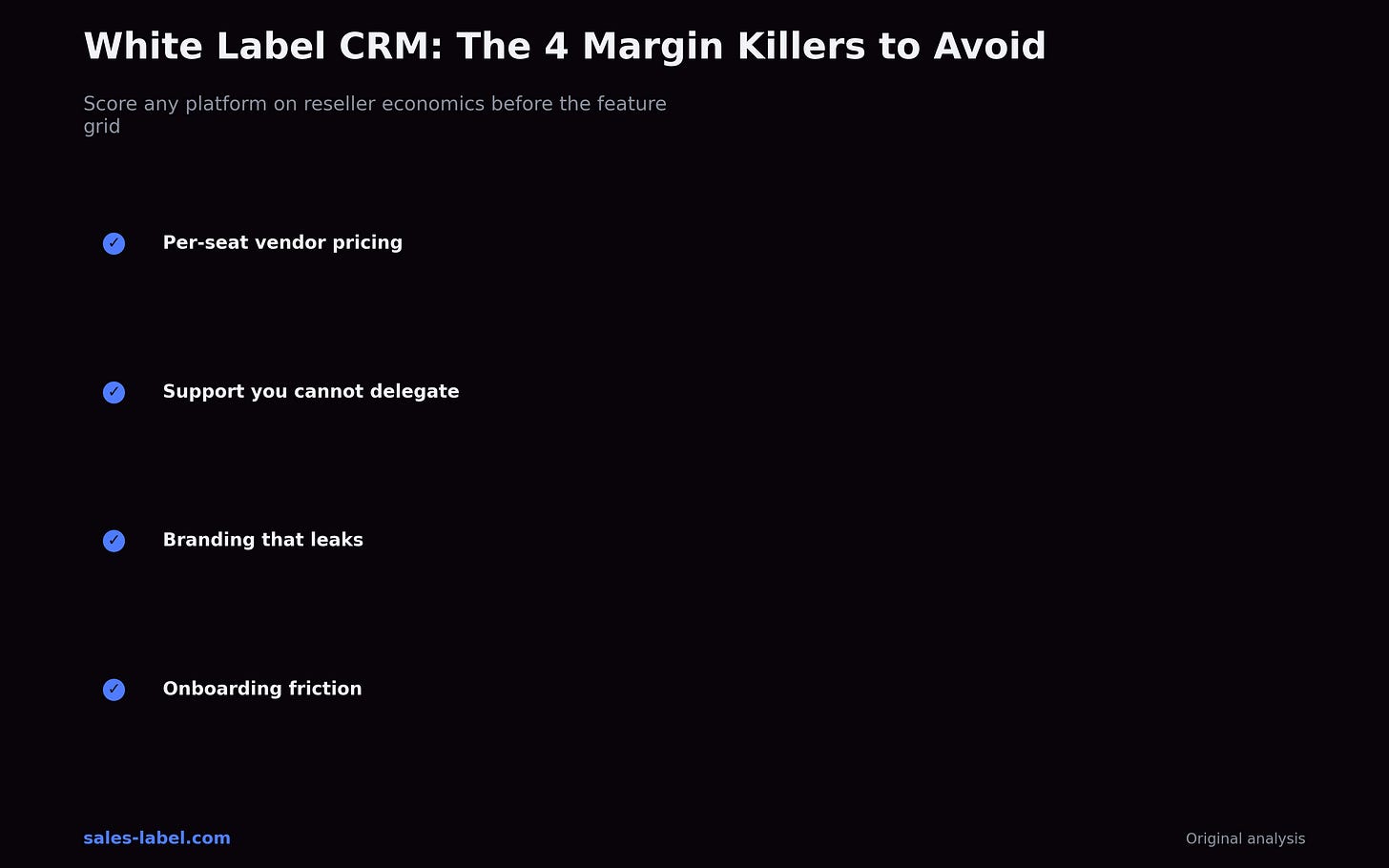
Plenty of platforms will slap your logo on a login screen. Far fewer are built so a reseller keeps healthy margin at scale. Four things quietly eat your profit:
Per-seat vendor pricing. If the vendor charges you per user, your margin shrinks with every seat your client adds. The best reseller deals are flat or tiered by account, so growth in your client base grows your profit instead of the vendor's.
Support you cannot delegate. When every client ticket lands on your desk, your "software business" is really a support business in disguise. A resellable white label CRM gives you tooling to handle tier-1 support efficiently — or a back-end support layer that stays branded as you.
Branding that leaks. A half-white-label platform hides the logo but exposes the vendor in emails, the domain, invoices, or the mobile app. Every leak undercuts your price and reminds the client they could go direct.
Onboarding friction. If it takes you two weeks of manual setup to launch each client, you cannot scale past a handful. Templates, bulk provisioning, and a clean setup flow are margin, not nice-to-haves.
Score any white label CRM on these four before you fall in love with its feature grid. A platform that wins on features but loses on reseller economics will bleed you slowly.
Original analysis — sales-label.com
The 6 questions to ask before you sign
Before you commit to a white label CRM vendor, get clear answers to these. Vague responses are a red flag.
How is my cost structured? Flat, tiered, or per-seat? Model your margin at 10, 50, and 200 client accounts — not just today's number.
What exactly carries my brand? Login, domain, emails, invoices, mobile app, support portal. Ask for the full list in writing; assume anything unlisted shows the vendor.
Who handles support, and under whose name? Confirm whether you get tools, a branded back-end team, or nothing.
How fast can I launch a new client? Ask for the real onboarding time with templates, not the demo-day fantasy.
What happens to my clients if I leave? Data ownership and export terms protect the relationship you are paying to own.
Is there a partner program? Co-marketing, deal support, and a real partner tier signal a vendor that wants you to succeed, not just to pay.
Get those six answered and you will avoid the traps that catch first-time resellers. See how a partner-first platform structures branding and margin on the white label and how it works pages.
White label CRM vs building your own
Some agencies still ask whether they should build instead of resell. The math almost always favors reselling. Building a CRM means hiring engineers, maintaining security and uptime, and shipping features forever — a multi-year cost before you earn a dollar. Reselling a white label CRM means you launch a branded product in weeks and put your energy into sales and service, where your margin actually lives.
The only case for building is if the CRM itself is your core intellectual property and your entire company is the product. For everyone else — agencies, consultants, managed-service providers adding recurring revenue — a white label CRM is the faster, cheaper, lower-risk path to a product line you own. You get the branded software and the recurring bill without the engineering payroll.
How to price your white label CRM
Pricing is where resellers leave money on the table. Do not just mark up the vendor cost. Price on the value your client gets: the CRM plus your setup, your support, your industry templates, and your ongoing advice. Bundle the software into a monthly package that includes your service, and the client buys an outcome, not a tool they could shop around.
A simple model works well: a monthly platform fee that comfortably covers your vendor cost and margin, plus a one-time onboarding fee that pays for setup. Tier it by client size or feature access so bigger accounts pay more. The goal is predictable recurring revenue that grows as you add clients — the whole reason to resell a white label CRM in the first place. Review your pricing every few clients: once your onboarding is smooth and your support tooling is dialed in, you can often raise the platform fee for new accounts without losing deals, because clients are buying your service and outcome, not shopping the underlying software.
Frequently asked questions
What is a white label CRM?
A white label CRM is a customer-relationship platform built by one vendor that you rebrand and resell as your own. Your clients see your brand and pay you; the vendor stays behind the scenes while you keep the margin.
Is a white label CRM profitable to resell?
Yes, when you pick one with reseller-friendly pricing (flat or tiered, not per-seat), full branding, and manageable support. Margin comes from bundling the software with your setup and service into a recurring package priced on value.
How long does it take to launch a white label CRM?
With a platform built for resellers, you can launch a branded CRM in weeks, not months — the vendor handles the software while you configure branding, pricing, and onboarding templates.
Can I keep my clients if I switch vendors?
Only if your contract guarantees data ownership and export. Always confirm the terms before signing, so the client relationship you paid to own stays yours.
The bottom line
A white label CRM is one of the fastest ways to turn an agency into a product business with recurring revenue — but only if you choose for reseller economics, not just features. Model your margin at scale, get the branding and support terms in writing, and price on value. Do that, and you own a branded software line without ever writing code. To see how a partner-first white label CRM is structured, book a demo and become a partner.