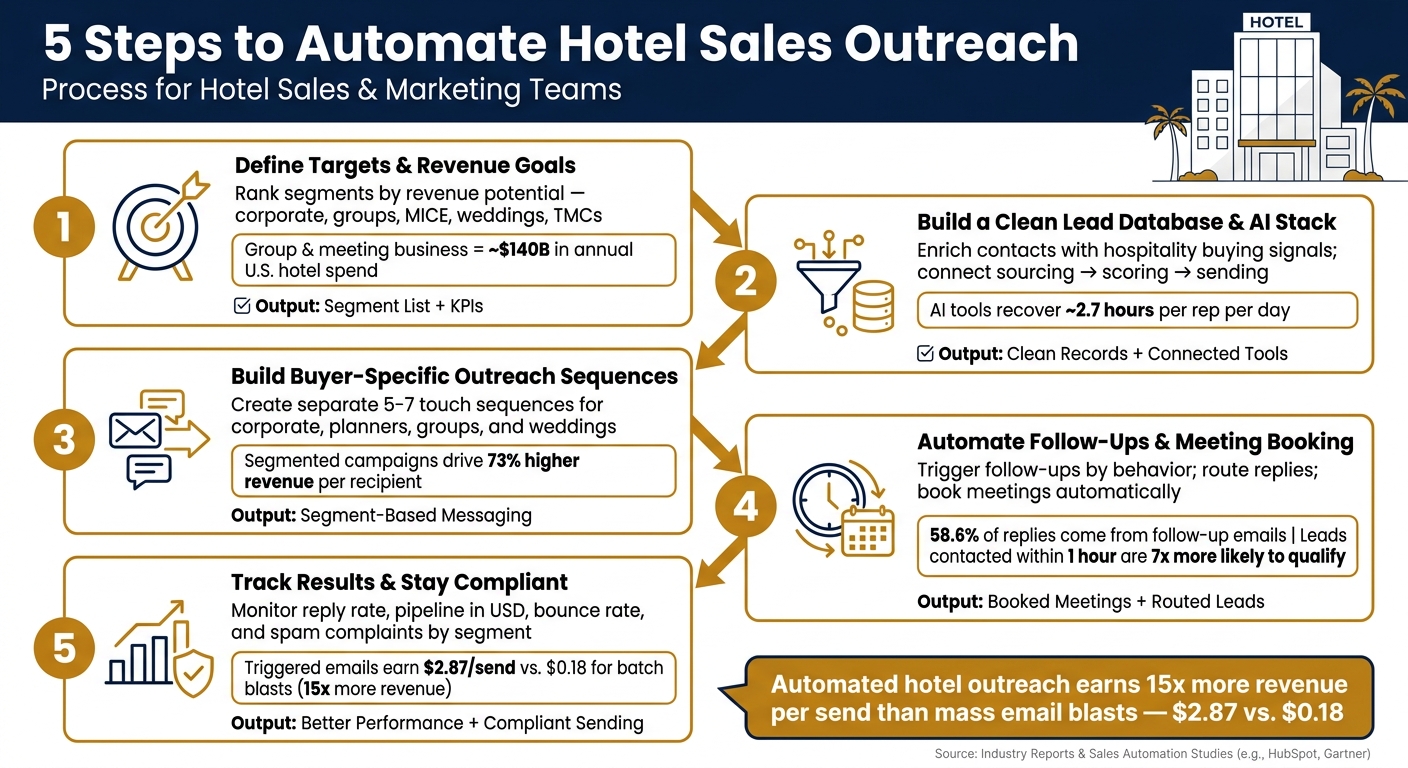
Systematize hotel outreach: target top segments, clean data, craft buyer-specific sequences, automate follow-ups, and track results.
SalesLabel Team
Growth Expert • 17.08.2026
Share:
Cauți o soluție gata de utilizare?
SalesLabel automatizează prospectarea de la un capăt la altul — AI găseşte prospecți, trimite mesaje personalizate şi rezervă întâlniri sub brandul tău.
Hotel sales teams lose hours to list building, email writing, and follow-ups. My takeaway is simple: if I want more booked meetings and more pipeline, I need a system that handles the repeat work while my team focuses on live deals.
Here’s the article in one plain-English view:
Pick the right targets first. I start with buyer groups that can bring in the most revenue, like corporate accounts, group business, and meeting planners.
Set dollar-based goals. I track things like reply rate, meetings booked, pipeline value, and contract conversion, not just opens.
Clean the lead data before sending. If names, titles, dates, budgets, and event details are missing or wrong, email personalization falls apart.
Build separate sequences by buyer type. A travel manager, wedding planner, and group organizer do not book the same way, so they should not get the same message.
Automate follow-ups based on behavior. Follow-up matters because 58.6% of replies come from follow-up emails, and more than 53% of meetings from email happen on step 3 or later.
Reply fast on high-value leads. Leads answered within 1 hour are almost 7x more likely to qualify.
Track results by segment and sequence. I look at reply rate, positive replies, meetings, and pipeline in USD, plus bounces, spam complaints, and unsubscribes.
Stay inside U.S. rules. Every email needs correct sender info, a real address, and an unsubscribe link under CAN-SPAM.
A few numbers stand out:
Group and meeting business accounts for about $140 billion in annual U.S. hotel spend
Full-service hotels may see 30%–35% of room nights tied to groups and meetings
AI tools can give back about 2.7 hours per rep per day
Triggered hotel emails can bring in $2.87 per send versus $0.18 for batch blasts
If I had to boil the whole article down to one idea, it would be this: good hotel outreach is not about sending more emails. It is about sending the right message to the right buyer at the right time, then routing replies fast.
5 Steps to Automate Hotel Sales Outreach [With Key Stats]
Hotel Sales Prospecting Playbook – Modernize Or Lose
sbb-itb-a781ab9
Quick comparison
Step
Main job
What I’m trying to fix
Main output
1
Define targets and revenue goals
Poor focus
Segment list and KPIs
2
Build lead database and AI stack
Messy data and manual work
Clean records and connected tools
3
Create buyer-specific sequences
Generic outreach
Segment-based messaging
4
Automate follow-ups and booking
Slow response and missed replies
Meetings and routed leads
5
Track results and compliance
Weak reporting and risk
Better performance and cleaner sending
So if I want hotel outreach to run like a system instead of a scramble, these are the five moves that matter most.
Step 1: Define Your Hotel Sales Targets and Revenue Goals
Before you build even one outreach sequence, get clear on two things: who you want to reach and what a win is worth in dollars.
Choose High-Value Segments
Start by ranking segments based on revenue potential, booking frequency, and fit for your property.
Focus first on corporate accounts, group bookings, event and meeting planners, wedding planners, travel managers, and tour operators. Groups and meetings make up about $140 billion in annual U.S. hotel spend and 15% of room nights. At full-service hotels, that share can climb to 30%–35%[1].
These top segments should shape the contacts, messages, and follow-up rules you automate next. Here’s a simple matrix to help you decide what to automate first:
A full-service hotel near a convention center should usually start with corporate accounts and event planners. A resort, on the other hand, will often get more from weddings and leisure groups. The point is simple: match your sales focus to your property type.
Set Clear KPIs in U.S. Business Terms
Each segment needs a dollar goal and a conversion goal.
A solid KPI set for hotel outreach automation includes reply rate, positive reply rate, meetings booked, qualified lead rate, proposal-to-contract conversion rate, and pipeline value. For most full-service and select-service properties, a healthy proposal-to-contract conversion rate lands between 25% and 40%[2][3]. If you’re stuck below 30%, the problem is often your follow-up cadence.
It also helps to set firm dollar thresholds that match how your hotel makes money. For many properties, $10,000 works as a practical qualification line. So a corporate campaign might aim for $50,000 in qualified pipeline each month. A group segment goal might be 10 signed contracts per quarter with an average value above $10,000.
Those numbers do more than look good on a dashboard. They tell your system which replies need human attention now and which ones should stay in nurture.
Use these targets to define the lead data you collect in Step 2.
Step 2: Build a Clean Lead Database and AI Outreach Stack
With your target segments and KPIs set in Step 1, the next step is to build the data layer that makes personalized outreach work at scale. This is where a lot of hotel sales teams stall out. They jump into email sequences too early, before their lead data is clean enough to support them.
Collect and Enrich the Right Lead Data
A hotel sales database should blend contact details with booking signals like room-night potential, event size, and timing. In practice, that means your database needs two layers: standard contact data and hospitality buying signals.
The standard layer includes full name, verified email address, direct phone number, job title, LinkedIn profile URL, company name, company size, industry, and decision-maker status. The hospitality layer adds event type, estimated event size, room-night potential, budget range, preferred travel dates, historical booking frequency, and location.
If those fields are missing, personalization starts to fall apart. Routing gets messy too.
Bad CRM data costs money, and records go stale fast, so enrichment can't be a one-time task. It needs to happen on a regular basis.
It also helps to standardize the basics across your system:
One primary contact per account
One unique record ID
U.S. dollar amounts
MM/DD/YYYY dates
That setup helps automation tools segment records the right way and stops personalization tokens from pulling blank fields in the middle of a campaign.
Set Up AI-Powered Outreach Operations
Once the database is clean, connect the parts of your workflow that turn lead records into booked meetings. A full hotel outreach stack ties together lead sourcing → enrichment → lead scoring → sequence generation → sending → inbox management → reply classification → meeting booking, all connected to the same record.
Lead scoring should weigh fit, intent, and revenue potential. Give higher scores to accounts that match your target segment and show near-term room-night or meeting demand. That way, your best prospects don't end up sitting in the same queue as colder, less qualified records.
For agencies managing outreach across properties, SalesLabel can run the full workflow under the agency's brand, from sourcing and enrichment to scoring, follow-ups, reply handling, and meeting booking.
AI tools that automate prospecting research, CRM logging, and sequence management can recover approximately 2.7 hours per rep per day[4]. That gives sales teams more time for higher-value conversations and follow-up. It also makes segmented outreach sequences faster to build and easier to personalize.
With clean data and routing in place, the next move is to build sequences that match how each hotel buyer segment books.
Step 3: Build AI Outreach Sequences for Hotel Buyers
Once your data is clean, the next move is to build sequences that match how each buyer actually buys.
A single, catch-all sequence won't work here. Corporate travel managers and wedding coordinators don't think alike, don't work on the same timeline, and don't care about the same details. So your message, your offer, and even your timing need to match the buyer's situation. Build separate sequences for each segment before you automate follow-ups in Step 4.
Segment Campaigns by Booking Type
The four segments that deserve their own sequences are corporate travel buyers, meeting and event planners, group bookings such as sports teams, tour groups, and family reunions, and weddings and social events.
For most hotel buyer types, a practical sequence includes 5–7 touches over 2–4 weeks. Spacing should get a bit longer as the sequence moves along, such as days 1, 4, 9, 15, and 22.[7][8][9][10][12]
Segment
Main Decision Trigger
Buying Cycle
Corporate travel
Negotiated rates, consistency, proximity to offices and clients, loyalty programs
Annual or multi-year contract cycle
Meeting and event planners
Meeting space specs, AV, room block management, F&B minimums, date flexibility
This kind of segmentation pays off. In hospitality, segmented campaigns drive 20% higher open rates, 70% higher click-through rates, and 73% higher revenue per recipient.[6][5]
After you define the segments, write each sequence around the buyer's main decision trigger. That's the core idea. A corporate buyer wants rate control and convenience. A planner wants the room setup to work. A wedding lead wants the space to feel right.
Personalize Messages with Hotel-Specific Details
Basic personalization - dropping in a first name and company name - just isn't enough now.
What does work is using specific property details tied to the buyer's goal. That's what makes the message feel useful instead of generic.
For a meeting planner, lead with hard facts they can use right away:
Our 12,000 sq ft of flexible event space across 8 breakout rooms can accommodate your Q4 leadership summit, with integrated AV and catering from $18 per person for breakfast service.
For a corporate travel buyer, focus on distance and rate:
We're a 5-minute walk from your client's downtown office, with negotiated corporate rates starting at $189/night.
For a wedding inquiry, speak to availability and setting:
Spring Saturdays in our Lakeside Ballroom - 2,800 sq ft with floor-to-ceiling windows - typically book 9–12 months out; we currently have April 18 and May 2, 2027 available.
AI can produce these versions at scale if it's working from a structured property facts sheet. That sheet should include room counts, meeting space square footage, layout types, F&B price ranges, parking details, and seasonal demand patterns.
And this part matters a lot: keep that data current. If pricing is old or specs are off, personalization falls apart the second a buyer replies with a follow-up question.
For send times, use Tuesday through Thursday from 10:00–11:00 a.m. or 2:00–3:00 p.m. local time.[9][10][11] For wedding and social leads, use 6:00–8:30 p.m.
These sequences should connect directly to the follow-up and booking rules in Step 4.
Step 4: Automate Follow-Ups, Reply Handling, and Meeting Booking
Step 3 got the sequence live. Step 4 is where replies turn into meetings.
Use the segment-based sequences from Step 3 to send people down different follow-up paths based on how they respond. That matters because follow-up emails drive 58.6% of all replies, and more than 53% of email-sourced meetings come from step 3 or later.[13]
Set Follow-Up Rules and Response Time Standards
The best follow-up systems react to behavior, not just the calendar. In plain English: what the prospect did should shape what happens next.
Open, no click → Send a reminder within 24–48 hours with one simple next step, like sample group rates or a meeting space overview.
Click, no reply → Follow up within 24 hours, mention the exact content they looked at, and offer 2–3 time slots for a call.
No open → Try again in 2–3 business days with a new subject line and a different angle. For example, shift from meeting space to negotiated rates.
Reply received → Remove them from the generic sequence right away and move them into a qualified-reply workflow based on what they want.
The trigger should also change by segment. A corporate buyer who clicks a rate sheet is not the same as a wedding lead who opens a venue brochure. Same system, different path.
Speed matters just as much as cadence. Leads contacted within one hour are nearly 7x more likely to qualify than those contacted later.[14][15] Even so, the average company takes 42 hours to respond to a new inquiry.[14][16]
For high-value hotel inquiries, like corporate contracts over $50,000/year, large group blocks, or RFPs with F&B minimums, aim to reply within one business hour. If the inquiry comes in after hours, use an automatic acknowledgment that sets a clear expectation:
You'll hear from us by 10:00 AM ET on Monday, August 17, 2026.
Once a prospect shows intent, move them straight into reply handling and meeting booking.
Route Qualified Replies and Book Meetings Automatically
From there, route each response to the right next step without making someone sort every reply by hand.
AI tools can classify incoming replies into clear intent buckets: interested, needs info, not now, out of office, wrong person, unsubscribe, and human review. Each one should trigger a specific action on its own. If someone asks to unsubscribe, future outreach should stop immediately.
For positive-intent replies, send the lead to the right rep based on segment and deal size. Group RFPs should go to the events team. Corporate rate requests should go to business travel. Large opportunities above $25,000 should be escalated to a senior account executive. SalesLabel can classify replies and route high-value inquiries automatically under the agency's brand.
When a reply is qualified, move to booking right away. You can do that with a scheduling link or by offering 2–3 time slots with the time zone labeled, such as 2:30 PM ET or 11:00 AM PT. Add a short note on what the meeting will cover, like a 30-minute review of sample group rates and meeting room layouts for the prospect's Q1 sales meeting.
After the meeting is booked, send an automatic calendar invite with:
the agenda
the location or video link
parking details
Every workflow should also include a human fallback for complex negotiations, VIP prospects, and sensitive replies.
Step 5: Track Performance, Improve Campaigns, and Stay Compliant
Meetings and pipeline only tell part of the story. You also need to know which segment, sequence, and follow-up path produced them. That’s what turns outreach data into monthly gains.
Monitor the Right Outreach Metrics
Start by tying each result back to the sequence, segment, and follow-up path behind it. Measure sequences, not just campaigns, so you can spot which hotel buyer groups move to conversion faster.
Open rate can point you in a direction, but it shouldn’t be the main goal. Focus on delivery rate, reply rate, positive reply rate, meetings booked and held, opportunity creation rate, and pipeline value in USD by sequence and segment. Keep each segment in its own row because conversion rates vary. Also track meetings booked per 1,000 sends, qualified opportunity rate, and pipeline value in USD by segment. Review trend lines every week and every month.[17][18][19][21][22]
(Opportunities × Avg. deal value × Win rate) ÷ Sales cycle in days
Once you can see the numbers clearly, set firm rules to protect deliverability and sender reputation.
You should also watch bounce rate, spam complaint rate, and unsubscribe rate each week. If any of those start to climb, clean the list before adding more volume. Use your reporting dashboard to keep an eye on these signals across client campaigns.
Refine AI Workflows and Follow U.S. Outreach Rules
If opens are high but replies are weak, the subject line is likely doing its job while the offer or call to action is falling flat. Test one variable at a time. Start with the subject line, then the opening sentence, then the call to action. If you change everything at once, you won’t know what actually drove the result.
Review a sample of AI-generated messages every week. Even a well-set system can drift into generic phrasing over time. That’s a problem, especially for luxury or boutique properties, where tone is part of the brand. Keep your brand guardrails tight. Personalize inside the brand voice, not outside it.
On the compliance side, U.S. outreach falls under CAN-SPAM. Under CAN-SPAM, every email must include accurate sender information, a truthful subject line, a valid physical address, and a clear unsubscribe link. Honor opt-outs within 10 business days and keep the link live for 30 days.[23][24][25][26] These rules apply to B2B hotel outreach too.[27]
Build suppression and unsubscribe handling into the workflow itself, not as a manual cleanup task. SMS and calls follow separate consent rules.
That way, the workflow can scale without hurting list health or creating legal risk.
Conclusion: Make Hotel Outreach a Repeatable Growth System
When these five steps work together, hotel outreach stops feeling like a one-time campaign and starts working like a steady growth system. You’re not just sending messages and hoping for the best. You’re building a pipeline that can keep running with the right timing, the right targeting, and the right follow-up.
The numbers make that pretty clear. Automated, triggered hotel emails bring in about $2.87 in revenue per send, compared with $0.18 for mass email blasts. That’s about a 15x increase, and it comes down to relevance and timing.[28] AI also cuts manual prospecting time and keeps follow-ups moving without the team having to chase every next step by hand. That’s why this five-step workflow is worth putting in place.
For agencies working with several hotel clients, the upside adds up fast. A white-label platform like SalesLabel helps you scale hotel outreach under your own brand without adding matching headcount.
Automate the busywork. Let the sales team stay focused on revenue.
FAQs
How do I choose which hotel buyer segments to automate first?
Start with hotel buyer segments that show the strongest intent and engagement, then grow from there based on what the data shows.
Use AI to enrich leads, group them by behavior, and assign fit and engagement scores. That gives your team a clearer picture of who’s most likely to reply, book, or take a meeting.
When you test automation, begin with the top-ranked segments first. Focus on the groups that lead to higher reply rates and more bookings. Then scale the segments that improve response rates and meeting outcomes.
This keeps the process simple: start where buyer interest is already high, test what works, and put more effort behind the segments that move the needle.
What data do I need before automating hotel outreach?
Start with a clear Ideal Customer Profile (ICP). Define the basics first: job title, seniority, department, company size, annual revenue, and location.
Then add technographics and behavior data. That includes the current tech stack, social media engagement, website activity, and intent signals.
Put together, these data points help you spot high-intent leads, rank them with more confidence, and time personalized outreach to the right decision-makers.
How can I tell if my hotel outreach automation is working?
Track results, not just the number of emails sent. Watch for higher reply rates and more booked meetings, check that messages are landing in inboxes, and make sure interested prospects move into your CRM or calendar through AI behavioral scoring.
You’ll also want to confirm that personalization, follow-ups, and lead data accuracy are doing what they should. If replies and meetings go up while manual work goes down, your automation is doing its job.