White Label Outreach Software: A Reseller's Buyer Guide
White label outreach software lets your agency resell prospecting under your own brand. See the 7 checks, how pricing works, and how to launch a branded offer.
SalesLabel Team
Growth Expert • 25/8/2026
Share:
¿Buscas una solución llave en mano?
SalesLabel automatiza la prospección de principio a fin — la IA encuentra prospectos, envía mensajes personalizados y reserva reuniones bajo tu marca.
White Label Outreach Software: A Reseller's Buyer Guide
White label outreach software lets your agency sell prospecting and outreach under your own brand, without building the technology yourself. Instead of reselling someone else's logo, you put your name on a proven platform, set your own pricing, and keep the client relationship. For agencies that already run outreach for clients, it turns a manual service into a scalable, branded product. This guide walks through what to look for, how the pricing works, and the questions that separate a real white-label partner from a thin logo swap.
What "white label" actually means here
There are three ways an agency can offer outreach technology, and only one of them is truly white label:
Reselling: you refer clients to a vendor and take a cut. The client sees the vendor's brand. You are a middleman, not the owner.
Co-branding: your logo sits next to the vendor's. Better, but the client still knows whose tool it is.
White label: the platform carries your brand end to end — the login, the dashboard, the reports, sometimes the domain. The client experiences it as your product.
True white label matters because it protects your margin and your relationship. When the software is branded as yours, clients cannot go around you to buy direct, and your agency becomes the platform, not just the service on top of it. That is the difference between charging for hours and owning a product line.
The seven things to check before you sign
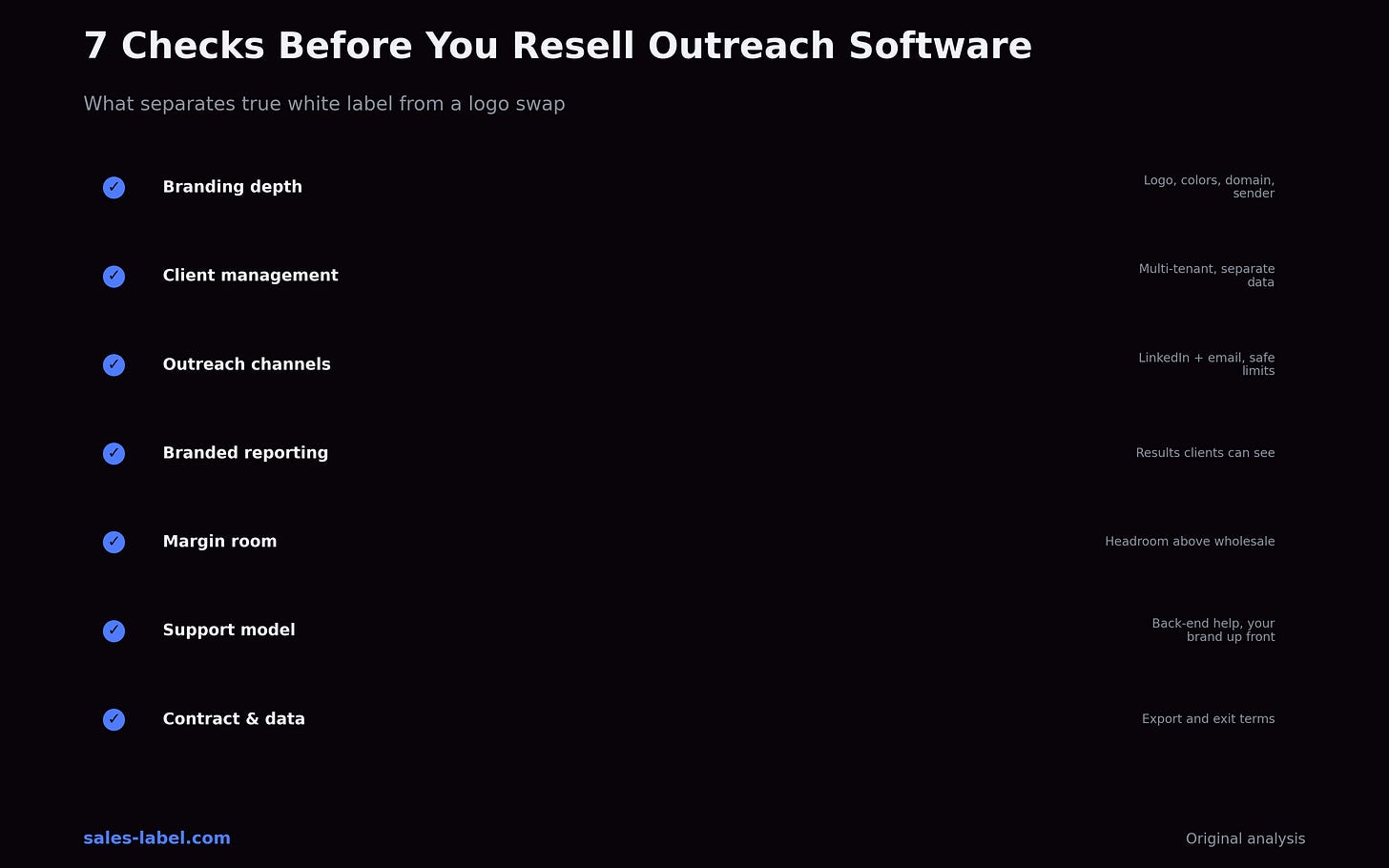
Not every "white label" offer delivers the same depth. Use this checklist to pressure-test any platform before you resell it.
1. Branding depth
Can you set your logo, colors, domain, and email sender? A tool that only swaps a logo in one corner is not the same as one that lets a client log in at app.youragency.com. Ask exactly which surfaces carry your brand.
2. Client management
Can you run multiple client accounts from one place, with separate data and permissions? Agencies live or die on multi-tenant control. If every client needs a separate contract with the vendor, it is not built for resellers.
3. Outreach channels
Does it cover the channels your clients actually use — LinkedIn, email, or both — with safe sending limits? A white-label tool that only does email leaves half the B2B motion on the table. LinkedIn-plus-email is the combination most agencies need.
4. Reporting you can put your name on
Clients pay for results they can see. Branded, clear reports on connections, replies, and meetings booked are what renew contracts. Check whether reports export under your brand and whether the numbers are ones a client will trust.
5. Pricing and margin room
What does the platform cost you per seat or per client, and how much headroom is left to mark up? A workable white-label deal leaves you a healthy margin after your service time. If the wholesale price is close to the retail price your market will bear, the math does not work.
6. Support and onboarding
When a client has an issue, who fixes it — and does the client ever see the vendor's name? Real white-label partners give you back-end support while keeping your brand in front. Ask how escalations work.
7. Contract and lock-in
Can you leave, export your data, and move clients if you need to? Understand the term, the data ownership, and any per-client fees before you build your business on the platform.
Seven checks that separate true white label from a logo swap.
How white-label outreach pricing usually works
Most white-label outreach platforms price one of three ways, and each shapes your margin differently:
Per seat: you pay for each sending account or user. Simple to predict, but costs climb as you scale clients.
Per client workspace: a flat fee for each client tenant, regardless of seats. Good when clients need several users each.
Tiered platform fee: a base fee unlocks a number of clients or contacts, with steps as you grow. Best for agencies planning to scale a product line.
The number that matters is your gross margin per client: retail price minus platform cost minus your service hours. A strong white-label offer typically leaves room to price the client well above wholesale while still delivering results — that spread is your product business. Model three client sizes before committing, so you know the offer holds up at small and large accounts.
A common mistake is pricing only against the platform cost and forgetting the service time. Setup, list building, message review, and monthly reporting all take hours, and those hours are part of your real cost. Price the client on the outcome — meetings booked, pipeline created — not on the wholesale seat fee. When the offer is framed as results rather than software access, clients compare it to the cost of hiring an outreach team, which is a much larger number, and your margin has room to breathe.
Build vs. buy: why agencies choose white label
You could build your own outreach stack. Most agencies should not. Building means engineering, compliance with LinkedIn and email rules, deliverability infrastructure, and ongoing maintenance — a full product team's worth of work before you send a single message. White-label software gives you that stack on day one, so you spend your time on strategy and client results instead of maintaining sending infrastructure.
The trade-off is control: you rely on a vendor's roadmap. That is why the checklist above matters. Pick a partner whose platform is deep enough that you rarely hit its limits, and the buy path wins on speed, cost, and focus. If you want to see what a full white-label outreach platform includes, explore our white-label platform and the AI features your clients would use under your brand.
A simple way to launch your offer
Once you have chosen a platform, packaging the offer is straightforward:
Name and price the product. Give it a brand, pick a monthly price with margin built in, and define what each tier includes.
Start with existing clients. The agencies already paying you for outreach are the easiest first buyers — you are productizing a service they already value.
Report relentlessly. Branded results reports are your retention engine. Show the meetings booked and the pipeline created, every month.
Do that, and a manual outreach service becomes a branded software line with recurring revenue you own. To see how the reseller model works end to end, take a look at how it works or book a demo to price your offer.
Frequently asked questions
What is white label outreach software?
It is a prospecting and outreach platform that an agency resells under its own brand. The login, dashboard, and reports carry the agency's name, so clients experience it as the agency's own product rather than a third-party tool.
How is white label different from reselling?
Reselling refers clients to a vendor whose brand they see, so you are a middleman. White label puts your brand on the whole experience, which protects your margin and stops clients from buying direct around you.
What should I look for in a white-label outreach platform?
Branding depth, multi-client management, the outreach channels your clients use (LinkedIn and email), branded reporting, enough pricing headroom for margin, back-end support, and fair contract and data-export terms.
Is white label cheaper than building my own tool?
For almost every agency, yes. Building requires engineering, deliverability infrastructure, and ongoing compliance work. White-label software provides that stack immediately, so you invest in client results instead of maintaining technology.