Agency Lead Generation: How to Scale Delivery Without Burning Your Team
Agency lead generation breaks at 5-10 clients. This playbook shows the 5-layer delivery system that scales across clients, the build-vs-white-label math, and the metrics that keep it honest.
SalesLabel Team
Growth Expert • 16/8/2026
Share:
¿Buscas una solución llave en mano?
SalesLabel automatiza la prospección de principio a fin — la IA encuentra prospectos, envía mensajes personalizados y reserva reuniones bajo tu marca.
Winning the client is the easy part. Delivering agency lead generation for ten clients at once — each with a different market, a different offer, and a different idea of what "a good lead" means — is where agencies quietly break. The team drowns in one-off tasks, quality slips, and the founder becomes the bottleneck for every campaign. This playbook is about the harder part nobody sells you on: how to build a lead-gen operation that scales across clients without burning out your people or your margin.
If you run leads for multiple clients, the goal isn't a bigger team. It's a repeatable system where adding a client adds revenue, not chaos. Here's how the agencies that scale actually do it.
Why agency lead generation breaks at 5–10 clients
Most agencies deliver their first few clients on hustle. It works — until it doesn't. The wall shows up around five to ten clients, and it's always the same three cracks:
Everything is custom. Each client got a hand-built setup, so nothing is reusable and every new client starts from zero.
Knowledge lives in heads. Only one person knows how a client's campaign runs, so time off or turnover puts delivery at risk.
The founder is the safety net. When something breaks, it lands on the owner — who is now doing delivery instead of growth.
Scaling an agency isn't about doing more work. It's about doing the same work the same way, so anyone on your team can run it.
The repeatable delivery system: 5 layers
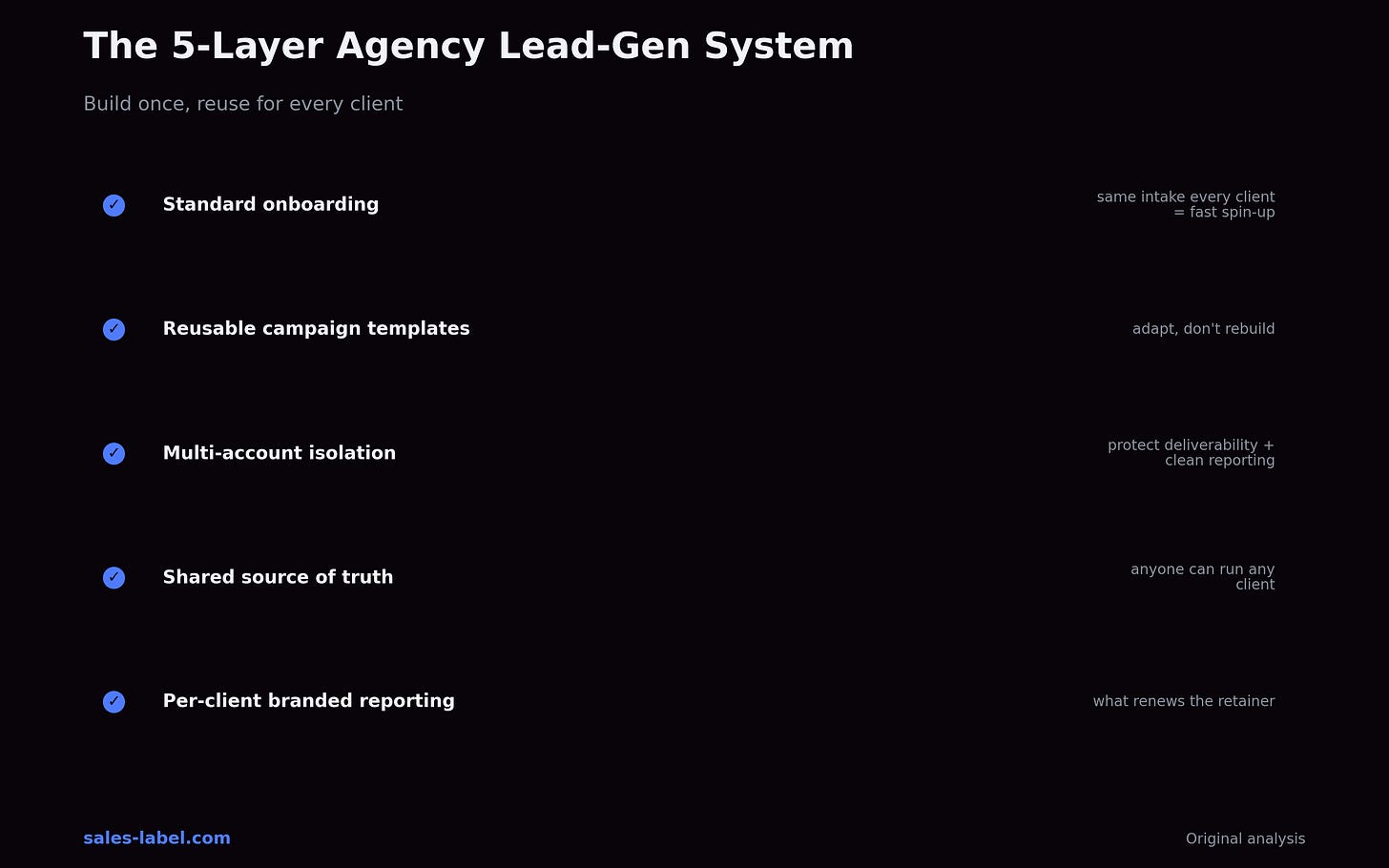
A lead-gen operation that scales has five layers, built once and reused for every client. Think of it as the machine your team runs, not the campaigns themselves.
1. A standard onboarding
Every new client goes through the same intake: ICP, offer, proof, targets, and access. A one-page brief captured the same way each time means anyone can build the campaign, not just the person who sold it. Standard onboarding is the single biggest lever for spin-up speed.
2. Reusable campaign templates
Stop rewriting sequences from scratch. Keep a library of proven message frameworks, targeting rules, and follow-up cadences that you adapt per client instead of rebuilding. Templates turn a two-day setup into a two-hour one.
3. Multi-account isolation
Each client's accounts, data, and sending stay walled off from the others. This protects deliverability and keeps one client's problem from spilling into another's results. It's also what lets you report cleanly per client.
4. A shared source of truth
One place where every campaign's status, leads, and next steps live — so a teammate can pick up any client in minutes. When knowledge lives in a system instead of someone's inbox, the founder stops being the bottleneck.
5. Per-client reporting
Automated, branded reporting that shows each client the leads and pipeline you generated. This is what renews retainers. A white-label reporting layer lets the results carry your client's brand, not a third-party tool's.
The 5-layer system that lets agency lead generation scale across clients. Original analysis, sales-label.com
Build vs. white-label: the honest math
Once the system is clear, you face the real decision: build every layer yourself or run it on a white-label platform. Building gives you total control and no per-seat cost, but it's months of engineering plus ongoing maintenance you have to staff. White-label gives you the multi-account isolation, shared source of truth, and branded reporting on day one, so your team spends time on client results instead of tooling.
The math usually favors white-label until you're large enough to justify a product team. If spinning up a new client takes days because you're stitching tools together, that delay is costing you margin on every retainer. A white-label lead-gen platform collapses that spin-up to hours and lets you resell the whole system under your own brand. Build when tooling is your moat; white-label when delivery speed is.
The metrics that keep delivery honest
Scaling without visibility is just scaling your risk. Track these four per client, every week:
Time-to-launch: how long from signed contract to first campaign live. If this is creeping up, your onboarding isn't standardized enough.
Leads per retainer: the number the client actually cares about. Watch the trend, not just the total.
Reply and positive-reply rate: the health of your messaging. A drop here is an early warning before the client notices.
Delivery hours per client: the hidden margin killer. If a client eats double the hours of others, either the price or the process is wrong.
When these live in one dashboard, you can spot a struggling account before the client emails you — and you can prove your value at renewal with numbers instead of promises.
How to add clients without adding chaos
The test of a real system is simple: can you onboard a new client this week without the founder touching the build? If yes, you've turned agency lead generation into a product you deliver, not a favor you perform. If no, fix the layer that's missing — usually standard onboarding or the shared source of truth — before you sign the next client. Growth built on an unstable base just breaks louder.
The mindset shift that makes it work
The agencies stuck at a handful of clients almost always share one belief: that their edge is doing something special for each client. It feels true, and it's the exact thing keeping them small. Custom work doesn't scale, and clients rarely pay a premium for a bespoke process they can't see — they pay for results.
The shift is to treat your delivery as a product with a standard spec, and your "customization" as a thin layer on top of a solid base. The base — onboarding, templates, isolation, source of truth, reporting — stays identical for every client. What changes per client is small: the ICP, the offer, the message angle. When you separate the reusable machine from the client-specific inputs, two things happen. Your team can run any account, because the machine is the same everywhere. And your margins climb, because you stop paying senior people to rebuild plumbing they've built ten times before. That's the whole game: sell outcomes, standardize the engine, and let the white-label layer make the engine look like it was built just for each client. Do that, and the next client is a revenue event, not a fire drill.
FAQ
How many clients can one lead-gen specialist handle? With a standardized system, a good specialist can run 8–12 clients. Without one, three or four will max them out. The difference is process, not talent.
Should agencies build or buy their lead-gen stack? Buy or white-label until you have the scale and engineering to justify building. Delivery speed usually beats owning the tooling, especially early on.
What's the fastest way to speed up client onboarding? Standardize the intake into a single repeatable brief and template your campaigns. Most of the delay is re-deciding things you've already decided before.
How does white-label help agency lead generation? It gives you multi-account isolation and branded, per-client reporting out of the box, so you resell a complete system under your own brand instead of building and maintaining one.
Turn delivery into a product
The agencies that scale don't work harder per client — they run the same reliable system for every client and make adding one feel routine. If you want to see how a white-label platform gives you multi-account delivery and branded reporting on day one, explore the platform or book a demo to become a partner. Build the machine once; sell it many times.