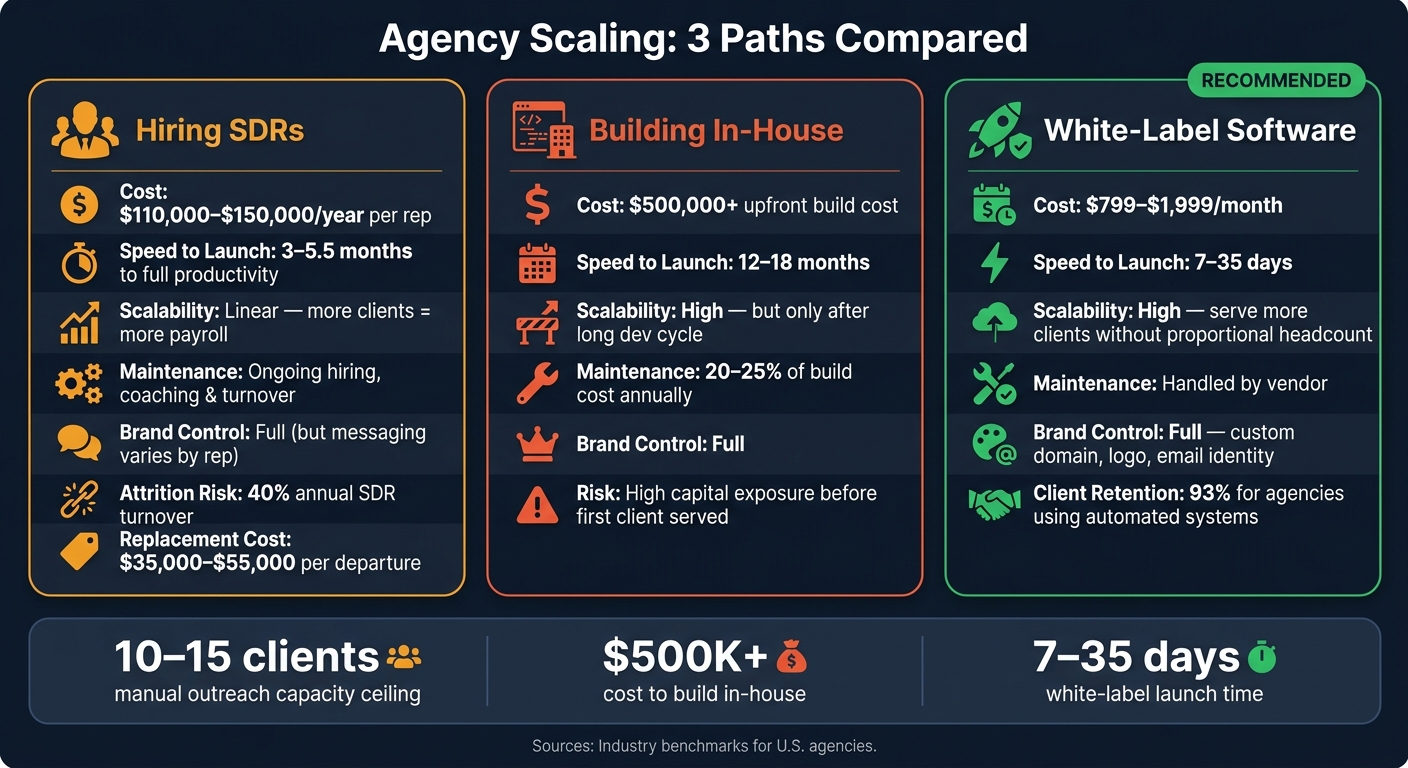
If I want my agency to grow without piling on staff, white-label software is often the simplest path. It lets me sell lead generation under my own brand while the platform handles the heavy work like sourcing, enrichment, outreach, follow-up, and booking.
Here’s the short version:
Manual outbound work often starts to crack at 10–15 active clients
One SDR can cost about $110,000–$150,000 per year
Building an in-house platform can cost $500,000+ and take 12–18 months
White-label software often costs about $799–$1,999 per month
Setup can take as little as 7–35 days
Agencies using automated white-label systems report 93% retention
In plain English: I can keep my branding, cut delivery work, lower labor pressure, and add a new monthly service without building software or hiring a full outbound team.
5 White Label SAAS to Resell Under Your Agency Brand in 2026
sbb-itb-a781ab9
Quick Comparison
Option
Cost
Time to Start
Main Tradeoff
Hiring SDRs
$110,000–$150,000/year per rep
Weeks to hire, then months to ramp
More clients usually mean more payroll
Building in-house
$500,000+ upfront
12–18 months
High cost and long wait
White-label software
$799–$1,999/month
7–35 days
Depends on vendor quality and setup
What matters most is this: white-label software helps me serve more clients, keep the client experience under my name, and avoid turning growth into a hiring problem.
The Scaling Problems Agencies Face
Those pressure points tend to hit first in everyday delivery.
Manual Outreach Limits How Far You Can Grow
Manual lead generation puts a hard ceiling on agency capacity. Prospecting, enrichment, personalization, follow-up, and inbox management all get slower as more accounts pile up. And once one person is handling five or ten clients, each with its own targeting rules and approval steps, things start to bog down. Mistakes creep in. Turnaround slows.
The numbers back that up. Manual prospecting caps agency capacity at 10–15 active clients before operations start to break down [2]. Slow response times can cause agencies to lose up to 30% of warm leads, and generic templates get 3x fewer replies than personalized outreach [2].
More Clients Can Mean More Complexity, Not More Profit
More clients don't always mean more margin. Sometimes they just mean more drag.
Every new account comes with its own ideal customer profile, tone of voice, reporting cadence, and approval process. That extra work stacks up with each client you add. So even if meeting volume goes up, profit doesn't always follow.
Agencies that rely on manual outreach lose an average of 23% of their client base every year because results are hard to predict [1]. And more booked meetings don't help much if the lead list is less precise and the team is spending more time chasing the wrong prospects.
Too Many Tools Slow Work and Weaken Data Quality
A typical outbound workflow usually runs across several disconnected tools. That means teams end up moving data by hand from one system to another. In plain English, they're exporting CSVs, copying fields, and trying to fix records that don't match.
In one operations dataset, 65.3% of agencies said manual or repetitive data entry was a major challenge, while 50% pointed to disconnected or poorly integrated systems [5]. That's a big warning sign.
When systems don't talk to each other, fulfillment gets fragile. Data goes stale. Updates get missed. Reporting falls behind what's happening right now. Then agency leaders can't answer basic questions like which sequence drove the most replies or which client account is taking the most team time.
Tool sprawl also adds more subscriptions, more logins, and more places for things to break without fixing the actual workflow.
That's why adding more people or piling on more tools rarely scales in a clean way.
Why Common Scaling Methods Fall Short
Hiring vs. Building vs. White-Label Software: Agency Scaling Cost Comparison
At that point, agencies usually end up choosing one of three paths: hire more people, build software in-house, or use white-label software. The real issue isn't just adding capacity. It's adding capacity without stacking on more overhead.
Hiring More SDRs Raises Costs Faster Than Capacity
Hiring more SDRs sounds simple on paper. In practice, the numbers get heavy fast.
A fully loaded U.S. SDR - including salary, benefits, payroll taxes, tools, and recruiting fees - usually costs $110,000–$150,000 per year[8][12]. And that person doesn't hit full output on day one. A new hire often needs about 3 months to become productive, and full quota capacity can take up to 5.5 months[7][9].
Then there's turnover, which hits this role hard. SDR attrition has been benchmarked at a median of 40% annually[11]. Each departure can cost an estimated $35,000–$55,000 in replacement costs and lost productivity [8][10]. So the agency isn't just paying salary. It's also paying for recruiting, training, management time, and the drop in output that comes with ramp-up and churn.
In plain English: more headcount can end up scaling a messy process instead of fixing it.
Building Internal Software Is Expensive and Slow
Some agencies look at building their own outbound platform and think, "We'll skip the monthly software bill and own the whole thing."
The problem is the upfront cost and timeline. A lead generation platform can cost $500,000+ to build and take 12–18 months to launch [4]. That's a long time to keep doing manual work, limit client capacity, and sink cash into a project that isn't the agency's main business.
And the spending doesn't stop after launch. Annual maintenance often lands around 20%–25% of the original build cost [6]. That includes security patches, API changes, bug fixes, and infrastructure work. If the platform starts lagging on AI features or data integrations, the agency can get stuck maintaining a tool that no longer gives it much of an edge.
Hiring vs. Building vs. White-Label Software: A Direct Comparison
For agencies, the test is simple: does this option help deliver more for clients without adding more operational drag? Here's how the three paths compare on the points that matter most for growth:
High - serve more clients without proportional headcount growth
Maintenance
Ongoing hiring, coaching, and turnover management
Engineering updates, security, infrastructure
Handled by the vendor
Brand Control
Full, but messaging consistency varies by rep
Full
Full - custom domain, logo, and email identity
White-label software closes those gaps with automation and brand control.
How White-Label Lead Generation Software Fixes the Problem
White-label software closes the gap between what agencies need to sell and what they can actually deliver. It automates fulfillment while keeping the whole experience under your brand. So you solve two problems at once - more delivery capacity and no extra headcount.
Automation Handles Repetitive Fulfillment Work
A lot of lead gen work follows the same pattern over and over. That makes it a good fit for automation.
Think about the tasks that eat up the most time:
lead sourcing
enrichment
outreach
follow-up
inbox handling
booking
These are structured jobs, which means software can handle them in a steady, reliable way. Instead of having your team buried in manual execution, they can spend more time on strategy, account direction, and client communication.
There’s another upside too. When these tasks live in one system, agencies cut down on tool switching and reduce data errors. That matters more than it sounds. Jumping between platforms slows work down, and small mistakes can pile up fast.
Automation cuts the workload. Branding keeps the client relationship in your hands.
Custom Branding Keeps the Client Relationship Yours
Custom domains, logos, and branded reporting make the software feel like your agency’s own system. That keeps your brand front and center at each client touchpoint instead of pushing it into the background.
Branded portals help too. They keep each account organized without making the client experience feel scattered or pieced together. From the client’s point of view, it all feels like one clean setup run by your team.
That helps protect trust and control.
SalesLabel: A White-Label AI Lead Generation Platform Built for Agencies
SalesLabel puts this model into one platform built around agency workflows. It automates sourcing, enrichment, outreach, follow-up, and booking under your brand.
It also includes:
AI replies
real-time lead scoring that highlights the best prospects
centralized inbox management that keeps replies in one place
Put together, those features cut tool switching and make it easier to run multiple client accounts from a single system. In plain terms, agencies can launch a lead generation offer faster and manage it with less overhead.
The Business Benefits for Agency Growth and Profitability
Serve More Clients Without Adding Headcount
Once delivery is automated, the next win is more profit per client.
Manual delivery puts a hard limit on capacity. One SDR can usually handle outreach for only 3–5 clients before results start to slip [2]. Too much context switching, admin work, and delayed follow-up pile up fast. In practice, manual prospecting often limits an agency to about 10–15 active clients before things get messy [2].
White-label automation changes that math. Instead of spending time on the day-to-day grind of execution, one account manager can focus on strategy, optimization, and client communication across a much larger client base. The platform does the heavy lifting.
Lower Your Cost to Deliver With Predictable Monthly Pricing
White-label software swaps payroll for a set monthly subscription based on active clients. SalesLabel's Starter plan starts at $799/month and includes a fully branded AI prospecting system, AI replies, and setup help.
That kind of pricing makes margin planning much easier. If a slower month hits, you're not stuck carrying the same labor cost with no easy way to trim it back.
Add a Lead Generation Offer Without Building a Department
Agencies can roll out lead gen as a service line without hiring SDRs or setting up a whole internal team. The agency owns the strategy, positioning, and client relationship. The platform handles execution.
Here’s what that can look like in plain terms: a digital marketing agency focused on paid media could add a $3,000–$5,000/month outbound retainer powered by a white-label platform. Existing staff manage the strategy, while automation runs delivery. That creates a new recurring revenue stream with very little added overhead, and it does it without building a new department.
Manual Delivery vs. White-Label Delivery: A Direct Comparison
These gains are much easier to spot when you put manual delivery next to white-label delivery.
Factor
Manual Delivery
White-Label Software Delivery
Staffing Needs
High - SDRs or VAs needed for every 5–10 clients [2]
Low - 1 manager can oversee many more clients through automation
Expanding - fixed software costs improve margins as you grow
Retention across agency accounts using automated white-label systems sits at 93%[1]. That matters because it gives agencies a steadier base of recurring revenue, without the nonstop scramble to replace churned accounts.
Before rollout, agencies need the right workflows and platform controls.
What to Check Before You Roll Out White-Label Software
Get Your Workflows in Order Before You Automate
Automation doesn’t fix a messy process. It scales it.
That’s why the first step is getting your workflow straight before you turn anything on. If the process is loose, the software will just move bad inputs through the system faster.
Start with your ideal customer profile (ICP). If your targeting rules are fuzzy, the platform can pull in and score leads that were never a fit in the first place. Set clear rules around company size, industry, and revenue range. Then add job titles, buying triggers, and disqualifiers before you touch any platform settings.
Next, clean up your CRM data. Duplicates, empty fields, messy activity logs, and vague ownership rules don’t stay small for long. Once automation starts, those issues tend to spread everywhere. Run a full data-cleaning pass before you connect any tool.
You’ll also want standardized messaging in place. That includes approved email templates, value props by segment, personalization rules, and tone guidance so AI-driven outreach stays on-brand. Pair that with documented SOPs for outreach, follow-up cadences, lead handoff, and meeting booking. When automation takes over, your team needs a playbook - not last-minute judgment calls.
What to Look for in a White-Label Platform
Once the workflow is clean, the platform decision usually comes down to control, automation, and support.
Branding depth matters more than many agencies think. You’ll want full brand control: a custom domain, branded dashboard, sender identity, and client-facing design that looks like yours, not the vendor’s.
On the automation side, look for AI sourcing, enrichment, outreach, follow-up, and scheduling that you can configure for each client. One-size-fits-all settings can get old fast when client needs start to vary.
Reporting should cover both campaign-level and client-level metrics. That means open rates, replies, booked meetings, and export options in a format your clients can actually use. And don’t skip scalability. Check how many client accounts you can manage and whether pricing still makes sense as you add more business.
Support also matters once the platform is live. Pick a team that works well with agencies and offers onboarding playbooks, templates, and fast replies when something breaks or needs setup help.
How to Roll It Out With Lower Risk
A careful rollout gives you room to catch issues early.
Pilot 1–3 clients for 60–90 days and budget 21–35 days before the first send [4]. During that window, track reply rates, meeting volume, and lead quality. Write down what’s working and what needs to change.
Sender warm-up is one of those steps people skip because it feels slow. That usually backfires. Agencies that ignore it often deal with weak deliverability for 90+ days [4][2].
If the pilot produces steady results, bring on more clients in small batches. Tighten your SOPs as you go, and keep manual oversight on your highest-value accounts during the shift.
Use the checklist below to compare vendors quickly.
A Simple Vendor Evaluation Checklist
Evaluation Area
What to Confirm
Setup time
Can onboarding and first campaigns launch quickly with guided support?
Data isolation per client, clear data ownership terms
A checklist helps you stay objective and avoids the kind of demo-driven mistakes that look good in a sales call but cause problems later.
Conclusion: White-Label Software Is a Smarter Way to Scale
For agencies running into capacity limits, white-label software gives them a cleaner way to grow. It cuts down on manual work, helps protect margins, and lets agencies turn lead gen into recurring revenue without piling on matching overhead. That means stronger margins and smoother client delivery.
Compared with hiring more SDRs or building software in-house, white-label software is faster to launch, lower risk, and easier to maintain. SalesLabel puts this model to work for agencies by automating lead sourcing, enrichment, personalized outreach, follow-ups, and meeting bookings under the agency's brand.
For agencies that want to grow without adding delivery overhead, white-label software is the simplest path forward.
FAQs
How do I know if my agency is ready for white-label software?
Your agency is likely ready for this if you want to scale lead generation without adding headcount or building custom infrastructure.
Agencies with 10 or more active clients may also see a better fit here, since single-sender pools often start to feel inefficient at that point.
If you want to launch a branded prospecting service within 7 days, set your own pricing, and build recurring revenue while keeping your brand front and center, this model can make a lot of sense.
What should I set up before automating lead generation?
Before you automate lead generation, nail down your ideal customer profile (ICP) and build your target lead lists.
Then get your email and LinkedIn sender accounts set up, finish the required warm-up period, upload your brand assets, and set your pricing model before you load your first prospect lists for testing.
How long does it take to launch a white-label lead gen service?
Agencies can usually launch a white-label lead generation service with SalesLabel in as little as 7 days. The setup is pretty simple: upload your brand assets and configure your domain.
That said, launch day isn’t the whole story. You should also plan for 21 to 35 days of warm-up time to build sender reputation and set the service up for steady, long-term performance.