White Label SaaS Pricing: How to Set Reseller Margins That Hold Up
White label SaaS pricing isn't the vendor's price plus a random markup. Learn the 3-tier margin model, your three real costs to serve, and the pricing mistakes that quietly kill reseller margins.
SalesLabel Team
Growth Expert • 12.08.2026 г.
Share:
Търсите готово решение?
SalesLabel автоматизира проспектирането от край до край — AI намира потенциални клиенти, изпраща персонализирани съобщения и резервира срещи под вашия бранд.
White label SaaS pricing is where most reseller businesses quietly leave money on the table. You found a great platform, slapped your logo on it, and picked a price that "felt right." Then margins came in thin, clients haggled, and you couldn't tell if the deal was even profitable. This guide fixes that — a clear method for setting reseller prices and margins that actually hold up.
Here's the core idea: your white label price is not the vendor's price plus a random markup. It's the value your clients get, minus what it costs you to deliver, with enough margin left to run and grow the business. Get that framing right and pricing stops being a guess.
Know your three real costs first
Before you can set a price, you need to know what a client actually costs you to serve. Resellers usually undercount this. There are three buckets:
Platform cost: what you pay the white label vendor per client, seat, or usage tier.
Delivery cost:onboarding, support, account management, and any custom setup — the human hours per client.
Overhead share: a slice of your sales, marketing, and admin cost allocated per client.
Add those three and you have your true cost to serve. Your price has to clear all three with room to spare — not just the platform fee. Most thin-margin reseller deals die because the owner priced against the platform cost alone and forgot delivery ate the rest.
Your markup isn't profit. Profit is what's left after platform, delivery, and overhead are all paid.
The 3×3 margin model for white label SaaS
Instead of one price, build a simple grid: three tiers of client value against three cost drivers. We call it the 3×3 margin model, and it keeps you profitable as clients scale up.
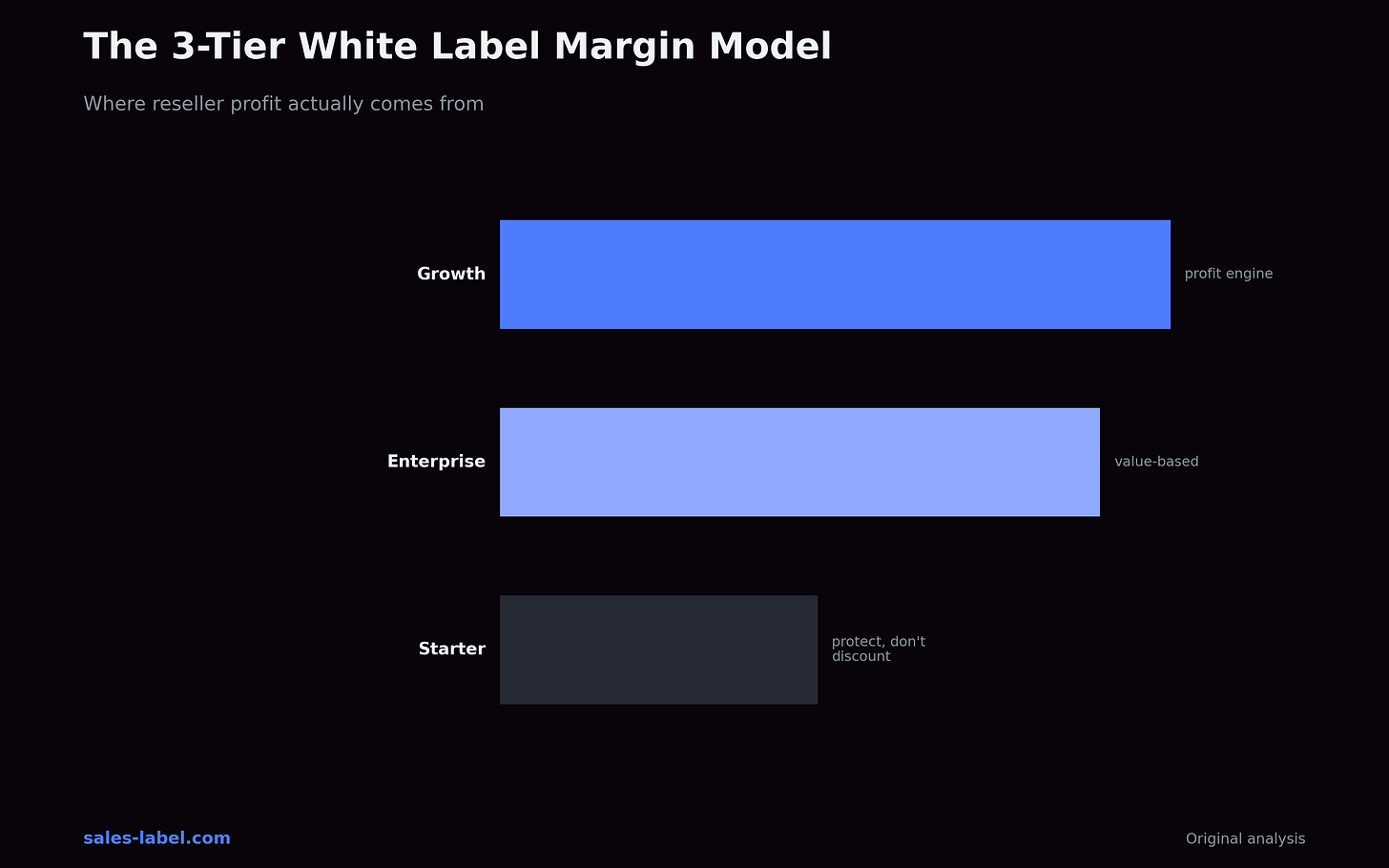
The 3-tier white label margin model — where reseller profit comes from.
Tier 1: Starter — protect your margin, don't chase volume
Small clients look attractive because they're easy to sign. But they carry the same onboarding and support burden as bigger ones, so their margin is fragile. Price Starter to fully cover delivery plus a healthy markup — resist the urge to discount it to win logos. A cheap Starter tier that loses money on support is a treadmill, not a business.
Tier 2: Growth — your profit engine
This is where healthy reseller businesses make their money. Growth clients use more of the platform, pay meaningfully more, but don't cost proportionally more to support once they're onboarded. Aim for your strongest margin here and design the tier so Starter clients have an obvious reason to upgrade into it.
Tier 3: Enterprise — value-based, not cost-plus
For your largest clients, stop pricing on cost entirely and price on value: what is the outcome worth to them? A white label platform that generates leads or books meetings for a big client is worth far more than your cost to deliver it. Enterprise pricing is a conversation about results, and it's where a white label reseller can earn premium margins.
How to set the actual numbers
A simple, defensible way to land on prices:
Start from cost to serve. Total your three cost buckets per tier.
Apply a target margin. Pure SaaS businesses famously run high gross margins — widely cited industry benchmarks such as the KeyBanc and SaaS Capital surveys put healthy SaaS gross margins around 70–80%. Resellers carry more delivery cost, so a realistic reseller target is a bit lower; set your markup to hit the margin you've chosen (source: KeyBanc SaaS Survey; SaaS Capital benchmarks).
Sanity-check against the market. Look at what comparable agencies and platforms charge, and position deliberately — premium, mid, or value.
Add a setup fee where real work happens. One-time onboarding fees recover delivery cost up front and filter out bargain-hunters.
Charge monthly for the platform, annually where you can (better cash flow and retention), and revisit prices at least once a year as your costs and the platform's capabilities change.
A worked example (so it's not just theory)
Imagine a Growth-tier client. Your platform cost for their usage is one figure, your delivery — onboarding plus ongoing support — is another, and you allocate a share of overhead on top. Say those three buckets together come to a "cost to serve" you know precisely for that tier. If you want to keep a strong gross margin, you don't add a flat markup; you price so the subscription clears cost to serve and leaves your target margin.
Now watch what happens across tiers. A Starter client with almost the same support burden but a smaller subscription barely clears cost — which is exactly why you never discount Starter to win logos. The same delivery effort applied to a Growth client, who pays far more, produces a much healthier margin. And an Enterprise client priced on the value of the outcome — pipeline generated, meetings booked, brand delivered — can pay a multiple of your cost without blinking, because you're no longer selling software by the seat, you're selling results. That single shift, from cost-plus at the top to value-based at the top, is where reseller businesses go from surviving to genuinely profitable.
The lesson from the example is simple: the same platform, sold three ways, produces three very different margins. Your job is to make sure most of your revenue sits in the tiers where the math works in your favor.
Pricing mistakes that quietly kill reseller margins
Cost-plus on the platform fee only. Ignoring delivery cost is the number-one margin killer.
One flat price for everyone. You either overcharge small clients and lose them, or undercharge big ones and leave profit behind.
Competing on price. A white label offer competing purely on being cheapest attracts churny, price-sensitive clients. Compete on outcome and support.
Never raising prices. Costs rise; if your prices don't, your margin erodes every year.
Pick a platform that protects your margin
Your margin starts with vendor economics. A good white label partner gives you predictable per-client cost, room to brand and price freely, and features valuable enough to justify Growth and Enterprise tiers. If you're evaluating platforms, our white label solution is built for reseller economics — transparent pricing, full rebranding, and AI features that give you a real value story to sell, not just a logo swap. See exactly how it works before you model your tiers.
Frequently asked questions
What margin should a white label SaaS reseller aim for?
Pure SaaS gross margins are famously high — according to commonly cited industry surveys (source: KeyBanc SaaS Survey; SaaS Capital) they run around 70–80%. Resellers carry extra delivery cost, so pick a deliberate target below that and hold to it. Enterprise, value-based deals can run higher. If you're under your target, revisit either your delivery efficiency or your pricing — usually both.
Should I charge a setup fee?
Yes, whenever onboarding involves real work. A one-time setup fee recovers your delivery cost up front, improves cash flow, and screens out clients who only want the cheapest option.
How do I price against cheaper competitors?
Don't match their price — change the comparison. Lead with the outcome your platform delivers, your support, and your reliability. Clients who buy purely on price churn fast; clients who buy on value stay and expand.
How often should I review white label pricing?
At least once a year, and any time your platform cost or feature set changes materially. Regular reviews stop silent margin erosion and let you pass new platform value on to clients as an upgrade.
This article was written with AI assistance and reviewed by the SalesLabel team.
Want help modeling reseller-safe pricing on a real platform?Book a demo and become a partner — we'll walk your tiers and margins together.