How to Start a White Label SaaS Business (6-Phase Playbook)
How to start a white label saas business without writing code: a 6-phase launch roadmap, a partner checklist, pricing, and how to land your first ten clients.
SalesLabel Team
Growth Expert • 26.08.2026 г.
Share:
Търсите готово решение?
SalesLabel автоматизира проспектирането от край до край — AI намира потенциални клиенти, изпраща персонализирани съобщения и резервира срещи под вашия бранд.
Learning how to start a white label saas business is one of the fastest ways to launch software revenue without writing a single line of code. You license a proven product, put your own brand on it, and sell it to your customers as if you built it. This playbook walks through the exact phases—from picking a product to landing your first paying client—so you can go from idea to launched offer in weeks, not years. If you run an agency or a service business, a white label saas is often the simplest new revenue line you can add.
What a white label saas business really is
A white label saas is software built by one company and rebranded and resold by another. The maker handles the code, hosting, and updates. You handle the brand, the customers, and the relationship. Your clients see your logo, your domain, and your pricing—never the vendor's. You keep the margin between what you pay the vendor and what you charge your customer.
This model works because building software is slow and expensive, but selling it is where the real leverage is. A white label reseller skips the hardest, riskiest part and goes straight to revenue.
The 6-phase launch roadmap
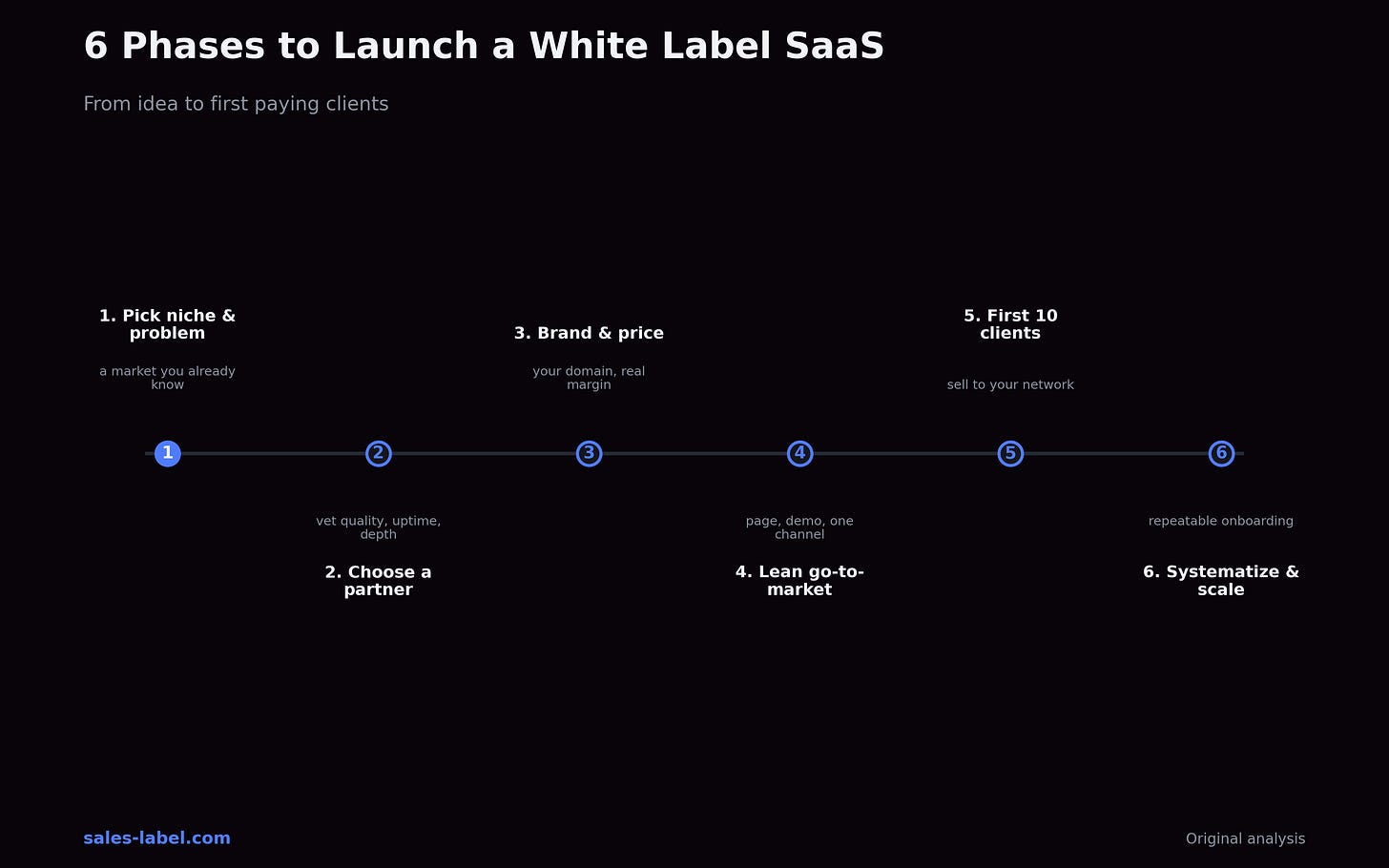
Starting a white label saas business follows a clear path. Here is the roadmap most successful resellers move through.
Original analysis — sales-label.com
Pick a niche and problem. Choose a market you already understand—agencies, coaches, local businesses—and a painful, recurring problem software can solve.
Choose a white label partner. Vet vendors on product quality, uptime, support, and true white-label depth: your domain, your logo, no vendor branding anywhere the client can see.
Brand and price your offer. Name the product, set up your domain, and build a simple pricing model with room for healthy margin.
Build a lean go-to-market. A landing page, a short demo, and one outreach channel are enough to start. Do not wait for perfect.
Land your first ten clients. Sell to your existing network first. Early customers give you testimonials, feedback, and cash flow.
Systematize and scale. Turn onboarding, billing, and support into repeatable steps so growth does not depend on you doing everything by hand.
How to choose the right white label partner
Your vendor becomes part of your product, so this choice matters more than any other. Run every candidate through the same checklist before you sign:
True white-labeling: your brand on the app, emails, and login—no "powered by" the client can spot.
Custom domain support: the platform runs on your subdomain, not the vendor's.
Reliable uptime and support: when the software breaks, your reputation is on the line, so the vendor's response time is yours too.
Fair, predictable pricing: wholesale rates that leave you real margin as you grow, with no surprise per-seat jumps.
Room to expand: a roadmap and feature set that lets you add products to the same clients later.
A strong white label lead generation or outreach platform checks all five boxes and gives your agency a product clients renew month after month.
Pricing your white label saas for profit
Pricing is where many new resellers leave money on the table. The simplest model is a monthly subscription that sits comfortably above your wholesale cost. Bundle the software with a service—setup, strategy, or managed campaigns—so you are not competing on software price alone. Clients happily pay more for software plus a person who makes it work. Aim for a margin healthy enough to fund your own sales and support, and review your prices as you add features and proof.
Resist the urge to undercut. A white label offer that also includes your expertise is worth far more than a bare login, and pricing it that way protects both your margin and your positioning.
How to find your first clients
The fastest path to your first sales is not cold outreach to strangers—it is your existing network. Agency owners, consultants, and service providers already talk to businesses that need what a white label saas delivers. Start there. Offer a small group of trusted contacts an early-access deal in exchange for honest feedback and a testimonial. Those first wins give you proof, case studies, and referrals that make the next sale easier.
From there, pick one channel and go deep. That might be LinkedIn outreach, a simple partnership with a complementary business, or a niche community where your buyers already gather. Trying to be everywhere at once spreads a new business too thin. One channel done well beats five done poorly, and it gives you a repeatable motion you can hand to a salesperson later.
Keeping clients: support and retention
In a subscription business, keeping a client is worth more than winning one. Churn quietly kills white label businesses that focus only on new sales. The fix is a simple, reliable onboarding and a fast response when something breaks. Because your vendor handles the software, your job is to be the helpful, human layer on top: quick answers, clear guidance, and the occasional check-in that shows you care about the client's results, not just their invoice.
Track two numbers from day one: how many clients you keep each month and how much each one is worth over time. When both climb, you have a real business. When retention slips, fix the experience before you spend more on new sales—patching a leaky bucket is always cheaper than filling it faster.
Common mistakes when starting out
Three mistakes slow most new white label businesses. First, picking a vendor on price alone and inheriting their outages and weak support. Second, trying to sell to everyone instead of owning one clear niche. Third, launching without a repeatable onboarding process, so every new client becomes a fire drill. Pick a solid partner, own a niche, and systematize early—that combination is what turns a side project into a real business.
Frequently asked questions
How much does it cost to start a white label saas business? Far less than building software yourself. Your main costs are the vendor's wholesale fee, a domain, and a simple landing page. Many resellers start on a low monthly plan and scale spend as clients come in.
Do I need technical skills? No. The vendor handles the code, hosting, and updates. Your job is branding, sales, and customer relationships—skills most agency owners already have.
How fast can I launch? With a partner in place, many resellers go live in two to four weeks: brand the product, stand up a landing page, and start selling to your network.
What is the difference between white label and reselling? A plain reseller sells another company's branded product and earns a commission. A white label reseller puts their own brand on the product and owns the customer relationship, the pricing, and the margin. White label gives you a real asset and far more control over how you grow.
Can I offer more than one white label product? Yes, and the best resellers do. Once you have earned a client's trust with one branded tool, adding a second—say, reporting or outreach alongside lead generation—raises the value of every account without the cost of finding a new customer.
Launch your white label offer
Now that you know how to start a white label saas business, the next step is choosing a partner you can build on. See how our white label platform lets you resell lead generation under your own brand, explore the AI features your clients will love, or book a demo and become a partner to launch your branded offer.