White-Label SaaS Reseller: How to Build Recurring Revenue Under Your Own Brand
Reselling software under your own brand adds recurring revenue without building a product. Here is how the white-label SaaS reseller model works, plus the 5 pillars of a profitable reseller business.
SalesLabel Team
Growth Expert • 8/14/2026
Share:
Looking for a done-for-you solution?
SalesLabel automates outbound end-to-end — AI finds prospects, sends personalized messages, and books meetings under your brand.
label SaaS reseller: build recurring revenue under your own brand" style="width:100%;border-radius:12px"/>
Reselling software under your own brand is one of the fastest ways to add recurring revenue without building a product from scratch. You take a proven platform, put your logo and pricing on it, and sell it to your clients as your own. Done well, a white-label SaaS reseller business turns a service agency into a product company with predictable monthly income. Done carelessly, it becomes a support headache with thin margins. This guide walks through how the model works and the five pillars that separate profitable resellers from the ones who quietly give up.
What a white-label SaaS reseller actually does
A white-label SaaS reseller licenses a finished software product from a vendor, rebrands it, and sells it to end customers under their own name. The vendor builds and maintains the technology; the reseller owns the brand, the customer relationship, the pricing, and often the first line of support. Your customers never see the vendor. To them, the product is yours.
This is different from being an affiliate or a referral partner, where you simply send leads and collect a commission. As a reseller you set the price, keep the margin between your cost and your sell price, and control the customer experience end to end. That control is exactly why the model scales: you are no longer trading hours for money, you are selling seats and subscriptions that renew every month.
Why agencies choose the reseller model
For a lead-generation agency, marketing shop, or consultancy, white-label reselling solves a structural problem: service revenue stops the moment you stop working. Software revenue does not. By packaging a platform your clients already need, outreach, lead generation, reporting, you add a recurring line item to every retainer and raise the lifetime value of each account. You also become stickier. A client who runs their daily work inside your branded platform is far harder to leave than one who just buys your hours.
The economics are appealing because the hard part, building and hosting the software, is already paid for by the vendor. Your job is distribution: brand, price, sell, and support. That plays directly to the strengths agencies already have.
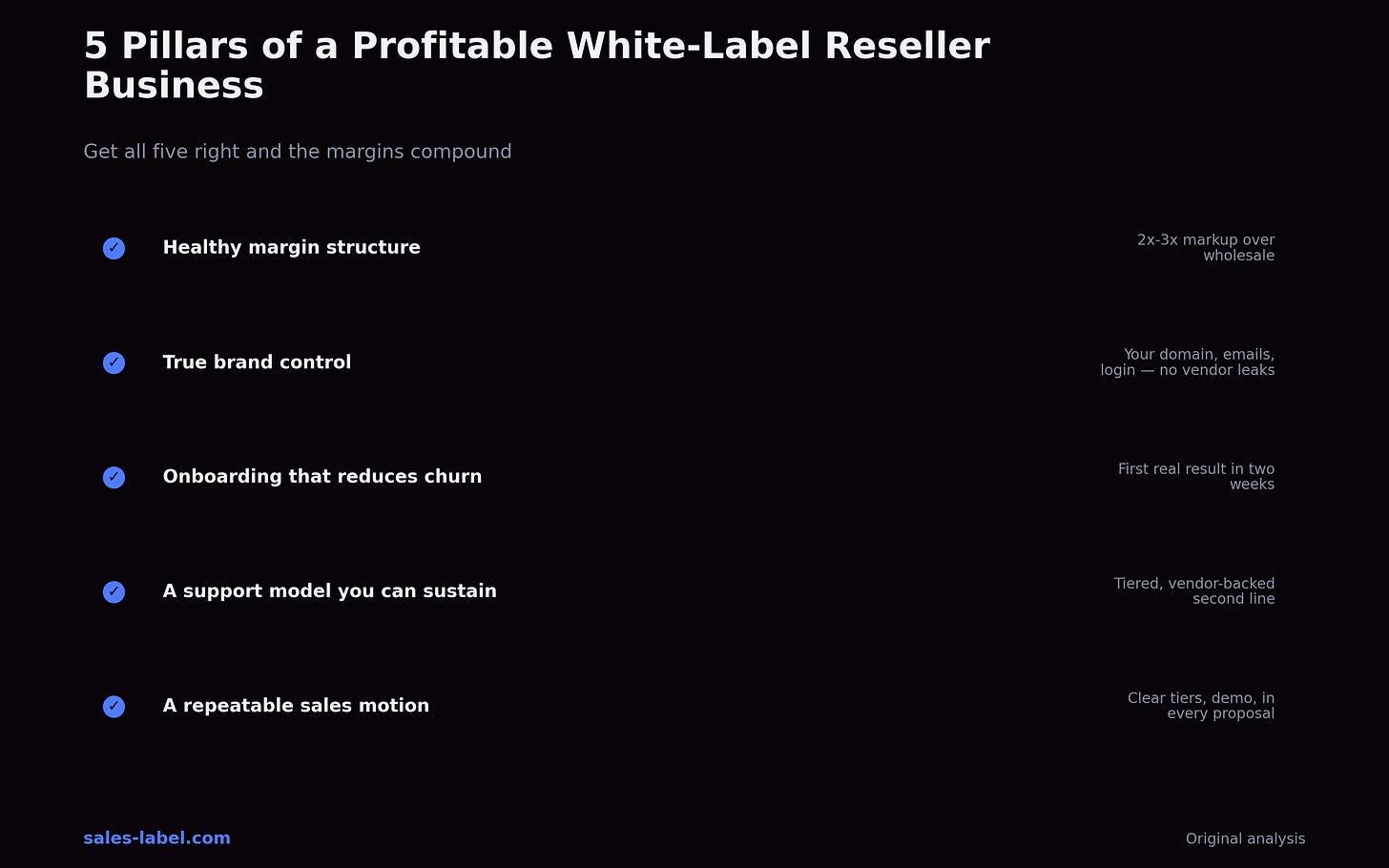
The 5 pillars of a profitable reseller business
Signing a reseller agreement is easy. Running a reseller business that actually makes money takes attention to five things. Get all five right and the margins compound; neglect one and it quietly eats your profit.
Pillar 1: A healthy margin structure
Your profit lives in the gap between what you pay the vendor and what you charge the client. Negotiate wholesale pricing that leaves room for a real markup, commonly a 2x to 3x margin once you factor in your support and account-management costs. Do not compete on being the cheapest; compete on the brand, service, and outcomes you wrap around the product. Price for the value your clients receive, not just the license cost you carry.
Pillar 2: True brand control
The whole point is that the product looks like yours. Before you commit, confirm how deep the white-labeling goes: your logo and colors, yes, but also your domain, your email sender, your login screen, and ideally no vendor references anywhere the customer can see. Shallow white-labeling, where the vendor's name peeks through in emails or support links, undermines the premium you are trying to charge.
Pillar 3: Onboarding that reduces churn
Recurring revenue only works if customers stay. The first two weeks decide that. Build a simple, repeatable onboarding flow that gets each new client to their first real result fast, a first campaign launched, a first batch of leads, a first report delivered. Every client who reaches early value renews; every client who logs in, gets confused, and drifts away becomes a cancellation next quarter.
Pillar 4: A support model you can sustain
As the brand the customer sees, you own the first support conversation. Decide early how you will handle it: a shared inbox, a help center, tiered escalation to the vendor for deep technical issues. Lean on the vendor's documentation and second-line support so you are not rebuilding an engineering team, but never leave clients feeling like no one is home. Responsive support is often the reason clients pay your price instead of hunting for the underlying tool.
Pillar 5: A repeatable sales motion
Finally, treat the product as a product, not a favor you offer existing clients. Package it into clear tiers, build a short demo, and add it to every proposal. Resellers who win create a standard way to pitch, price, and close the platform, so adding it to a new client takes minutes, not a custom conversation each time.
The 5 pillars of a profitable white-label reseller business — original framework by SalesLabel.
Common reseller mistakes to avoid
Underpricing to win the deal. A thin margin leaves nothing to fund support, and support is what keeps clients.
Skipping onboarding. Handing over a login and hoping for the best is the number-one cause of churn.
Choosing a vendor with shallow white-labeling. If the vendor's brand shows through, you cannot charge a premium.
Treating it as a side offer. The resellers who profit build a real sales motion around the platform.
There is one more trap worth naming: picking a vendor purely on price. The cheapest wholesale license often comes with the shallowest white-labeling, the weakest support, and a product your clients will outgrow in a quarter. When that happens you inherit the churn, the support tickets, and the awkward migration, all of which cost far more than the few dollars you saved per seat. Evaluate a reseller partner the way your clients evaluate you: on reliability, depth of branding, and the quality of the help behind the product, not the sticker price alone.
Getting started as a reseller
The best first step is choosing a vendor whose white-label program is deep, whose product your clients already need, and whose margins leave room for you to build a real business on top. If you want to see how a white-label reseller partnership works in practice, from branding and margins to onboarding support, explore the white-label platform or see how it works, then book a demo to map it to your client base and become a partner.
Frequently asked questions
What is the difference between a reseller and an affiliate?
An affiliate refers leads and earns a commission but never owns the product or price. A white-label reseller licenses the software, rebrands it, sets the price, keeps the margin, and owns the customer relationship end to end.
How much margin can a white-label SaaS reseller make?
Margins vary by product and market, but a 2x to 3x markup over wholesale is common once you account for support and account management. You keep the difference between your vendor cost and your sell price on every renewal.
Do I need technical skills to resell SaaS?
No. The vendor builds and hosts the software. Your work is branding, pricing, selling, onboarding, and first-line support, which plays to the strengths agencies and consultancies already have.
How do I keep reseller customers from churning?
Get every new client to a first real result within their first two weeks and provide responsive support. Strong onboarding and reliable help are what turn a monthly subscription into years of recurring revenue.