White Label AI SDR: How Agencies Resell Autonomous Prospecting (2026)
A white label AI SDR lets agencies resell autonomous sales development under their own brand. Learn what it includes, how the reseller model works, and how to price it profitably.
SalesLabel Team
Growth Expert • 8/22/2026
Share:
Looking for a done-for-you solution?
SalesLabel automates outbound end-to-end — AI finds prospects, sends personalized messages, and books meetings under your brand.
A white label AI SDR lets an agency sell autonomous sales development under its own brand — the prospecting, the personalized outreach, the follow-up — without building the technology or hiring a floor of junior reps. For agencies, it is one of the cleanest ways to add a high-margin, recurring service in 2026. This guide explains what a white label AI SDR actually is, how the reseller model works, and how to price and deliver it so it strengthens your brand instead of quietly commoditizing it.
The demand is real. Every B2B client wants more meetings, and most cannot afford to build or manage an in-house SDR team. An AI SDR closes that gap: it researches accounts, writes first-touch messages, sequences follow-ups, and books replies into a calendar — at a fraction of the cost of a human seat. White labeling it means your agency delivers that outcome under your own name, on your own domain, with your own pricing.
What a white label AI SDR includes
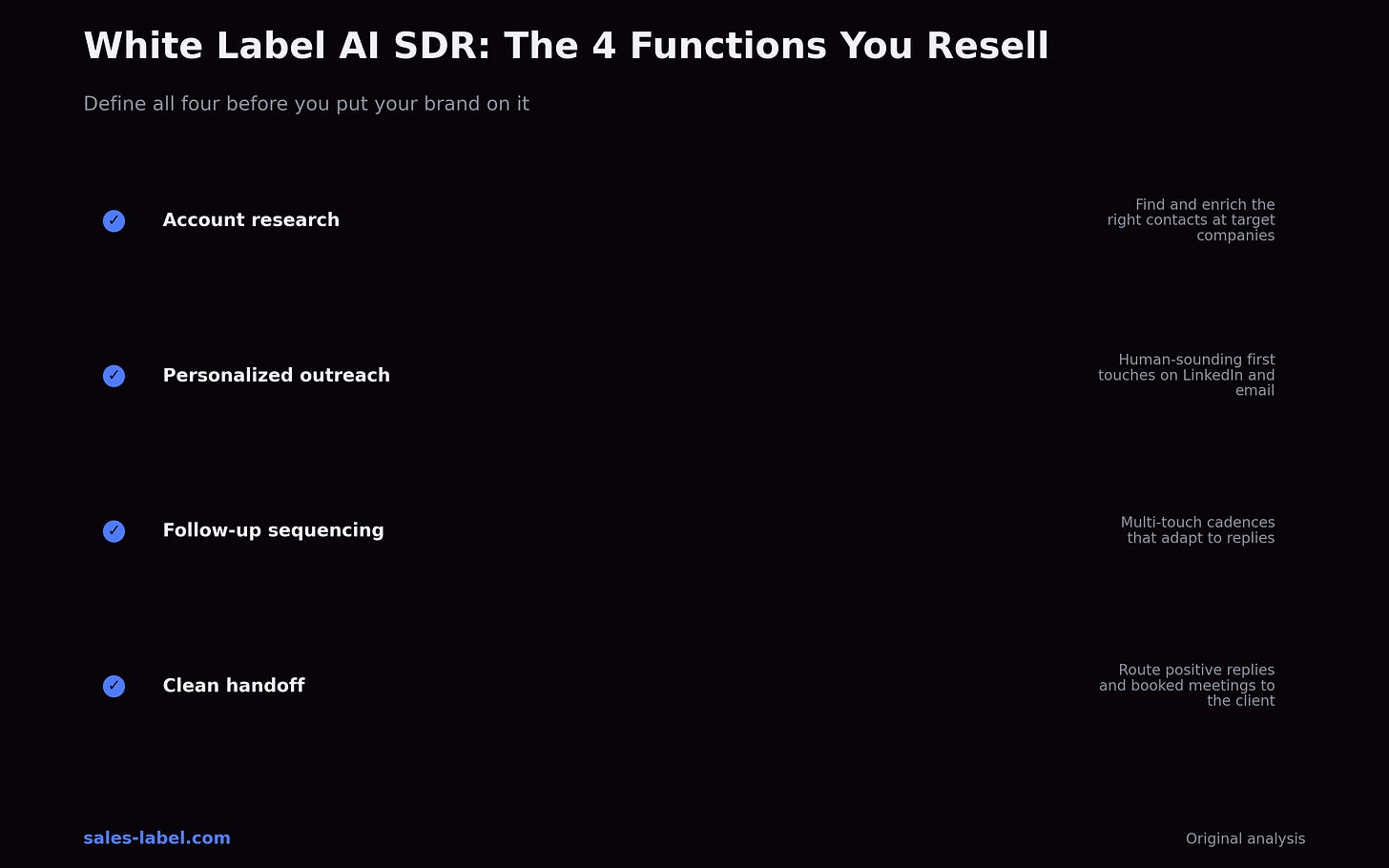
"AI SDR" is a broad label, so define the deliverable before you resell it. A complete white label AI SDR covers four functions:
Account research: identifying and enriching the right contacts at target companies.
Personalized outreach: drafting first-touch messages on LinkedIn and email that read like a person wrote them.
Follow-up sequencing: pacing multi-touch cadences and adapting to replies.
Handoff: routing positive replies and booked meetings to the client's team cleanly.
When you resell all four under your brand — your logo, your dashboard, your client login — the client experiences it as your product. That brand ownership is the whole point of white label, and it is what separates a reseller from a referral partner.
Why agencies choose white label over building
Building an AI SDR in-house means model costs, deliverability infrastructure, LinkedIn features">automation that stays inside safe limits, and ongoing maintenance as platforms change. That is a product company's job, not an agency's. White labeling flips the math:
Speed to revenue: launch a new service in days, not quarters.
Predictable margin: you pay a wholesale rate and set your own retail price.
No platform risk: the vendor absorbs the technical upkeep and compliance work.
Focus: your team stays on strategy and client relationships, where your value actually lives.
Original analysis — sales-label.com
How the reseller model works, step by step
A white label AI SDR partnership usually follows the same path:
Sign a reseller agreement that sets wholesale pricing, brand rights, and support terms.
Brand the platform — your domain, logo, and client-facing dashboard.
Onboard each client with their ICP, offer, and messaging, which the AI uses to personalize outreach.
Run and monitor campaigns, reviewing reply quality and meeting volume.
Report under your brand so the client sees your agency delivering the results.
The vendor handles the engine; you own the relationship and the outcome. Done well, the client never needs to know a third party exists — and that is exactly how it should feel.
White label is not about hiding a vendor. It is about owning the outcome your client actually buys: booked meetings under your name.
How to price a white label AI SDR service
Pricing is where agencies leave money on the table. Avoid pricing purely on your wholesale cost plus a small markup; price on the value of a booked meeting to the client. A single qualified meeting can be worth thousands in pipeline, so a monthly retainer that reflects meetings delivered — not seats or send volume — is both easier to sell and more profitable. A common structure is a fixed monthly management fee plus a per-meeting or performance component. Whatever you choose, keep your wholesale cost invisible to the client and anchor the conversation on outcomes.
Bundle it, too. An AI SDR pairs naturally with services you may already resell, so a client can buy prospecting, nurture, and reporting as one branded package. If you are building out a broader reseller stack, our white-label platform and AI features are designed to sit under your brand end to end, and the how-it-works overview walks through the delivery model.
Which clients are the best fit
A white label AI SDR does not suit every client, and pretending otherwise leads to churn. The strongest fits share a few traits. They have a clear ideal customer profile and a proven offer, so the AI has good raw material to personalize. They value meetings over vanity metrics, which makes outcome-based pricing an easy conversation. And they lack the appetite or budget to hire and manage SDRs directly — the exact gap your service fills. Growing B2B service firms, SaaS companies without a full sales team, and consultancies that sell high-ticket engagements tend to convert and retain best. Screen for these traits during your sales process and you will spend less time rescuing accounts that were never going to work.
What the vendor should handle versus what you own
A clean division of labor keeps the partnership healthy. The vendor should own the technology, deliverability infrastructure, model quality, LinkedIn safety limits, and platform uptime — the parts that require engineering and constant maintenance. You own everything the client touches: the brand, the relationship, onboarding quality, campaign strategy, and reporting narrative. Problems appear when these blur. If you find yourself troubleshooting deliverability or model behavior, your vendor is underdelivering; if the vendor is talking directly to your client, your white label is leaking. Agree on these boundaries in writing before the first campaign, and revisit them quarterly as you scale the number of accounts you run.
Common pitfalls to avoid
Two mistakes sink white label AI SDR programs. The first is overselling volume: promising a flood of meetings and then burning the client's domain reputation with aggressive sending. Protect deliverability and set honest expectations. The second is skipping onboarding: an AI SDR is only as good as the ICP and offer you feed it, so a rushed setup produces generic outreach that damages your brand. Treat onboarding as the most important week of the engagement, not a formality.
FAQ
What is a white label AI SDR? It is an AI-powered sales development service — research, outreach, follow-up, and meeting booking — that an agency resells under its own brand instead of building the technology itself.
How is it different from hiring human SDRs? It delivers the same core outcome, booked meetings, at lower cost and without the hiring, training, and turnover of a human team. Many agencies use it to scale delivery without scaling headcount.
Can I set my own prices? Yes. You pay a wholesale rate and set your retail price. Pricing on the value of meetings delivered, rather than cost-plus, is the most profitable approach.
Will clients know it is white labeled? No. The platform, dashboard, and reporting carry your brand and domain, so the client experiences the service as your agency's own product.
How fast can I launch a white label AI SDR service? Because the technology already exists, most agencies can brand the platform and onboard a first client within a week or two. The limiting factor is usually your own sales and onboarding process, not the tooling — which is exactly why the reseller model is attractive.
What margins are realistic? Since you pay a wholesale rate and price on the value of meetings delivered, healthy recurring margins are the norm when you sell on outcomes rather than cost-plus. Protecting deliverability and onboarding quality is what keeps those margins durable over the life of the account.
Written with AI assistance and edited for accuracy.