How Does White Label Lead Generation Work? The Flow From Client to Leads (2026)
White label lead generation is a service one company delivers that you resell under your own brand: your client hires you, a hidden vendor finds and contacts the leads, and the results come back under your logo. This explainer follows the whole relay step by step, maps who does what across the client, the reseller and the vendor, shows where the leads really come from (LinkedIn and email), and is honest about the limits no vendor can promise away. It ends on the one link that decides your margin: the vendor you choose.
SalesLabel Team
Growth Expert • 11/27/2026
Share:
Looking for a done-for-you solution?
SalesLabel automates outbound end-to-end — AI finds prospects, sends personalized messages, and books meetings under your brand.
White label lead generation works like this: your client hires your brand, you quietly hire a specialist vendor, and the leads land under your name. The client never meets the vendor. One link in that chain decides whether you keep the margin or lose the account, and we save it for the end.
This guide follows the whole path, from the first client call to the branded report. No theory. Just who does what, where the leads come from, and where new agencies get burned.
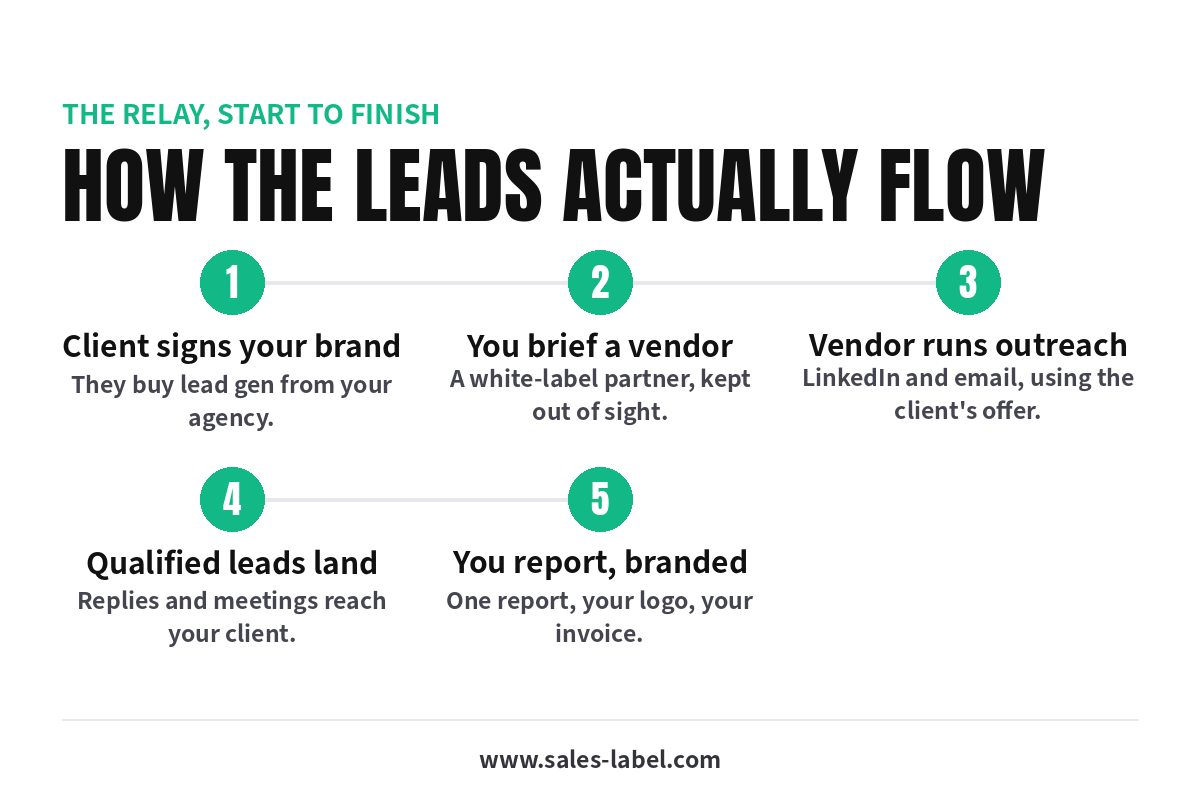
white label lead generation flow from client signing with your brand to a branded report, with a hidden vendor in the middle" width="1200" height="800" loading="lazy" decoding="async">The whole model in five steps. The client sees step 1 and step 5; the vendor does step 3 out of sight.
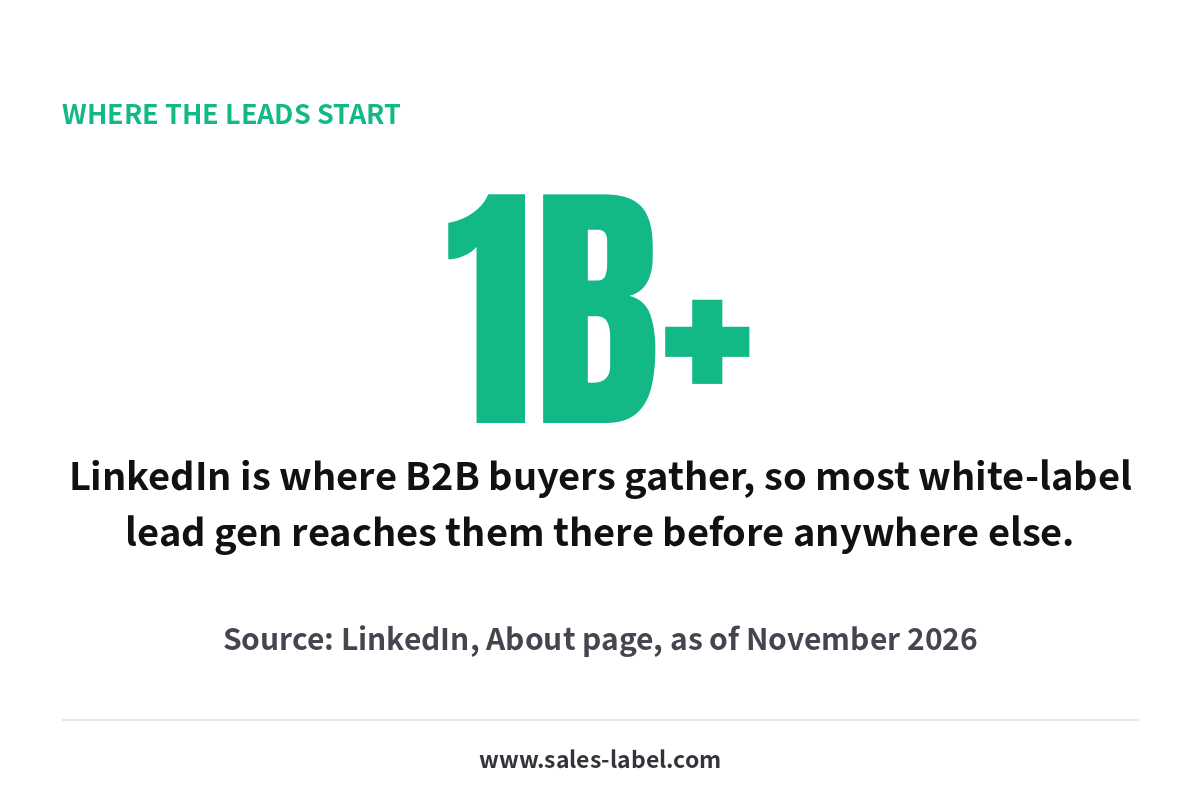
Most of these leads start on one channel. LinkedIn says it has more than 1 billion members in more than 200 countries and territories, which is why most B2B lead gen reaches buyers there.
LinkedIn's own figure. It is why the first channel most vendors run is LinkedIn, not a bought list.
What is white label lead generation?
White label lead generation is a service one company delivers that you resell under your own brand. You sign the client and own the relationship. A vendor behind the scenes finds and contacts the leads. The client sees only you.
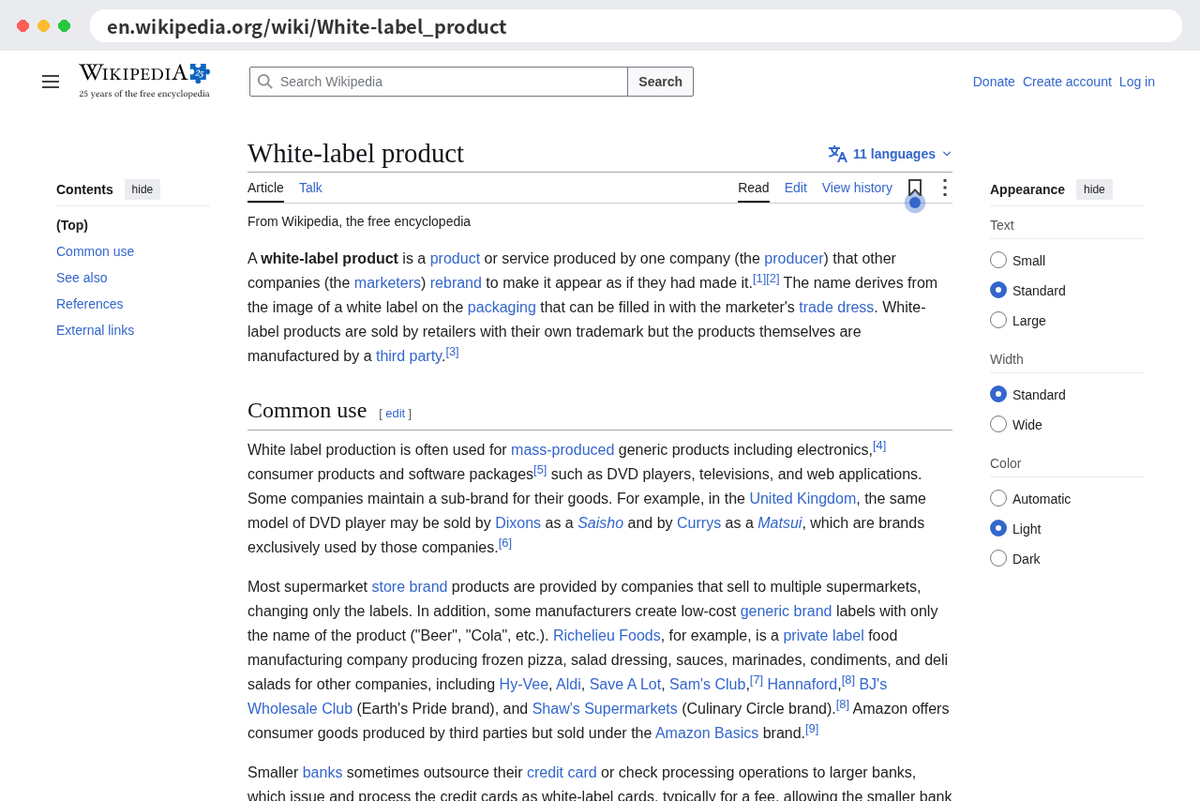
The phrase has two plain parts. "White label" means a product made by one firm and sold under another firm's name. "Lead generation" means finding people who might buy and getting them to raise a hand.
A white-label product, by definition: made by one company, sold under another's brand. Lead generation just makes it a service. Screenshot: en.wikipedia.org, 2026-11-27
White label vs in-house vs referral
These three get mixed up. They are not the same.
White label: you resell a vendor's work as your own. Your brand, their delivery.
In-house: you hire and train your own team. Your brand, your delivery.
Referral: you send the client to another firm for a cut. Their brand, their delivery.
White label sits in the middle. You get the client-facing brand of in-house without the cost of building a team.
How does white label lead generation work, step by step?
It works as a relay. The client hands work to you, you hand delivery to a vendor, and leads flow back the other way under your brand. Here is the full loop.
The client signs with your brand. They buy "lead generation by [Your Agency]". They never see a vendor.
You brief a white-label vendor. You pass the target market, the offer and the message. The vendor stays invisible.
The vendor runs the outreach. They find the right people and contact them on channels like LinkedIn and email, using your client's offer.
Qualified leads arrive. Replies and booked calls land in your client's inbox or calendar, with your agency as the sender.
You report under your logo. You send a branded report showing leads, replies and meetings. The client judges you by it.
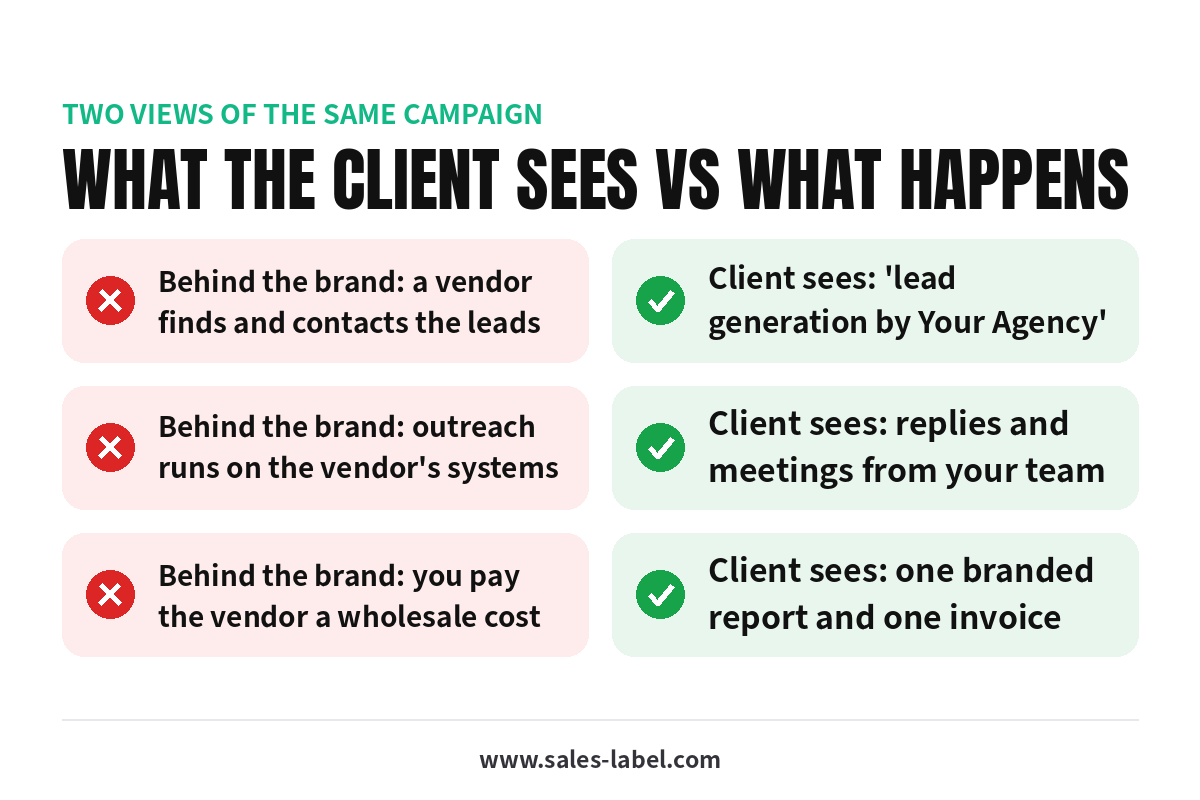
Same campaign, two views. Keeping the left column invisible is the craft of the model.
The client experience is simple on purpose. Complexity is the vendor's job. Your job is the brand, the offer and the relationship.
Who does what: your client, you, and the hidden vendor
Three parties, three clear roles. Getting this straight is how you price it and how you avoid promising work you cannot do.
Who
What they do
What they see
Your client
Pays, approves the offer, takes the meetings
Only your brand and your reports
You (the reseller)
Sell, set strategy, manage the vendor, report
Both sides: the client and the vendor
The vendor
Finds leads, sends outreach, books meetings
Only the brief, never your client directly
That gap is not a trick. It is the model: your brand out front, a vendor doing delivery behind it.
Notice who the client never talks to. That gap is the whole point, and keeping it clean is the skill.
Where do the leads actually come from?
The leads are not bought from a list in the dark. A good vendor generates them on live channels, the same way an in-house team would.
The main channels
LinkedIn outreach: connection requests and messages to a tight target list of decision-makers.
Cold email: short, relevant emails to verified work addresses.
Multichannel follow-up: a mix of both, spaced out, so one quiet channel does not kill the campaign.
The honest part: no channel finds everyone. Some emails stay hidden and some people never reply. A vendor who promises a fixed find rate or a guaranteed number of meetings is selling a story. Treat ranges as estimates, not contracts.
Is white label lead generation legit?
Yes. Reselling a service under your own brand is a normal, legal business model used across marketing, software and SEO. It is only a problem when the delivery itself breaks a platform's rules or the law.
Two things keep it clean:
Respect the channel's rules. LinkedIn and email providers have limits on volume and automation. A vendor who ignores them puts your client's accounts at risk, and the fallout lands on your brand.
Be honest about outcomes. You can promise effort and process. You cannot promise a buyer will say yes.
Want to see the mechanics before you sell it? This short explainer walks through how the white-label agency model fits together.
Here is the payoff we promised. In the whole relay, the client is yours and the brand is yours, but the delivery is not. The vendor is the one link you do not control, and it decides everything.
Pick a weak vendor and you still own the client's bad result. Pick a strong one and you keep a clean margin while they do the hard part.
So the real work here is not the outreach. It is choosing, briefing and managing the partner who does it. Set your price above their cost, keep the gap, and the model runs.
That is the model our platform is built for: you run the brand and the client; we power the delivery underneath. Book a white-label demo to see how it would look under your name.
How does white label lead generation work in simple terms?
You sell lead generation under your brand, a hidden vendor delivers it, and the leads come back to your client with your name on them. You keep the difference between what the client pays and what the vendor charges.
Does the client know a vendor is involved?
No. The client only ever sees your brand, your reports and your team. The vendor stays behind the scenes, which is the whole point of the white-label model.
Where do the leads come from?
From live channels, mainly LinkedIn and cold email. A good vendor finds the right people and contacts them with your client's offer, the same way an in-house team would.
Is white label lead generation legal?
Yes. Reselling a service under your own brand is a standard, legal model. It stays clean as long as the delivery respects each channel's rules and you are honest about outcomes.
How do agencies make money from it?
You charge the client more than the vendor charges you. That gap is your margin. The stronger and cheaper your vendor, and the higher the value you package, the better the margin.
Can a vendor guarantee a number of leads?
Be careful with guarantees. No channel reaches everyone, so a fixed find rate or a promised number of meetings is usually a sales story. Treat any number as an estimate, not a contract.
 white